


Two weeks ago, Vladimir Guerrero Jr. hit his first home run at Rogers Center this season. It was a rotten cherry on top of a curdled sundae season for Vladdy.
Not long after, a clip from an interview surfaced in which Vlad said, in effect, that he was paid for what he had already done, not necessarily for what he was going to do. This comes as the Blue Jays are eliminated from the playoffs after being one out from the World Series.
To his credit, Vlad was critical of his season and how bad he was, but that doesn’t make his comments any less tone-deaf. Even though, in a way, he is right, from a certain point of view…..
Players who play five seasons in a row accumulating less than 1 bWAR a year are not going to get a $200 million contract. Players who produce 5 bWAR a year will. So, by that thinking, Vladdy is right. He is getting paid for what he has done. Fans and teams don’t want to hear that, though, especially as they are falling apart.
So, it got me thinking: who are a few other players who signed big contracts and then seemed to give up on themselves? I pulled seven contracts and ran some data. For each player, I pulled their regular-season line before and after signing. PA, home runs, AVG, OPS, and a few Statcast numbers.
Editor’s Note: I got this data on September 23rd, so it may be slightly off. Also, there are some pretty obvious examples like Anthony Rendon that have been beat to death. So, I avoided him.
Vladimir Guerrero Jr. — $500 million, 14 years
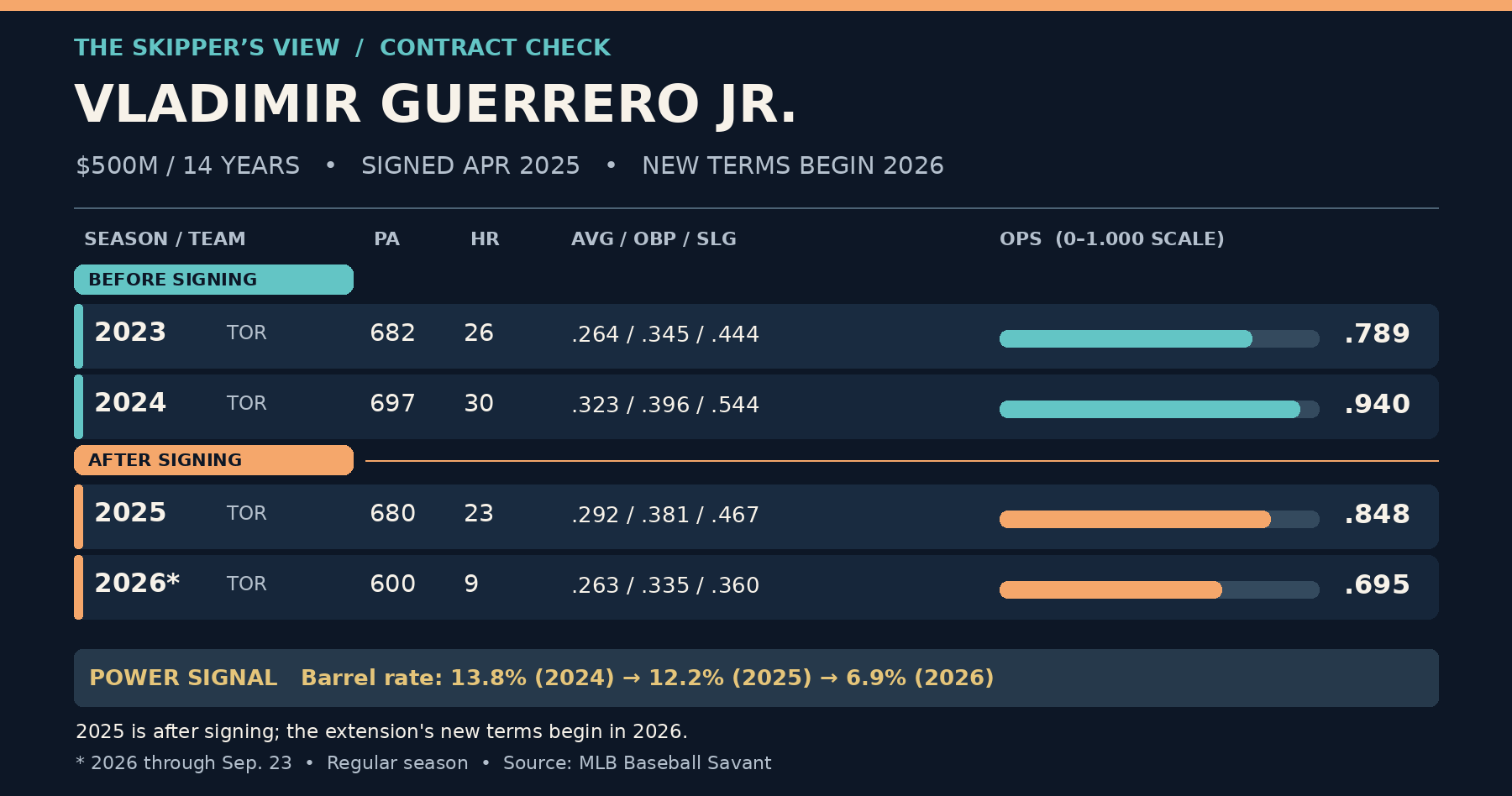
Vladdy had 30 homers and a .940 OPS in 2024. Toronto then agreed to the extension that would pay him $500 million over 14 years. He responded with another solid season, though worse than 2024, and helped the team reach the World Series.
Now for the part fans are right to be angry about: He is at nine homers and a .695 OPS in 600 PA in 2026. His barrel rate went 13.8% in 2024 → 12.2% in 2025 → 6.9% in 2026, and expected slugging fell .578 → .506 → .405. We now have three straight years of regression in important categories.
My read: He earned the extension with past production, and Toronto is paying for future production. Both statements can be true. The first contract year is a serious disappointment. One rough year, even one accompanied by a terrible quote, is not evidence that he quit working.
Anthony Santander — $92.5 million, five years
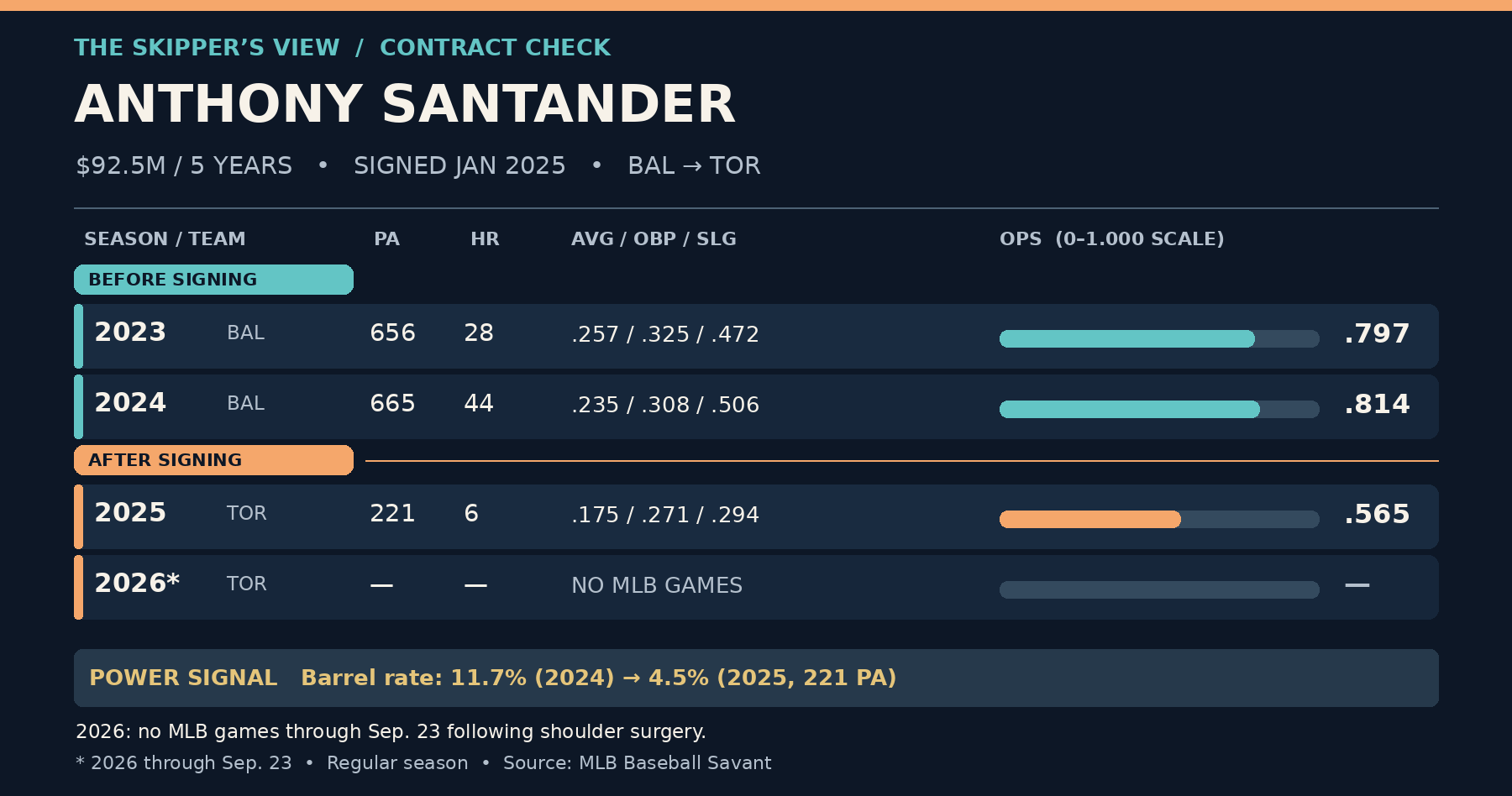
Anthony Santander hit 44 home runs in 2024. A significant jump from his 28 in 2023. Lucky for me, I had him on my dynasty team during his breakout year, but I traded him immediately.
Toronto signed him in January 2025 to $92.5 million over five years. His first Blue Jays season was six homers, a .565 OPS, and 221 PA. His barrel rate dropped 11.7% → 4.5%.
Obviously, huge caveat: he got injured. But when he was healthy, he started off terribly.
My read: The return so far is dreadful. Availability is the central story, which makes this one of the weakest cases for an effort accusation.
Willy Adames — $182 million, seven years
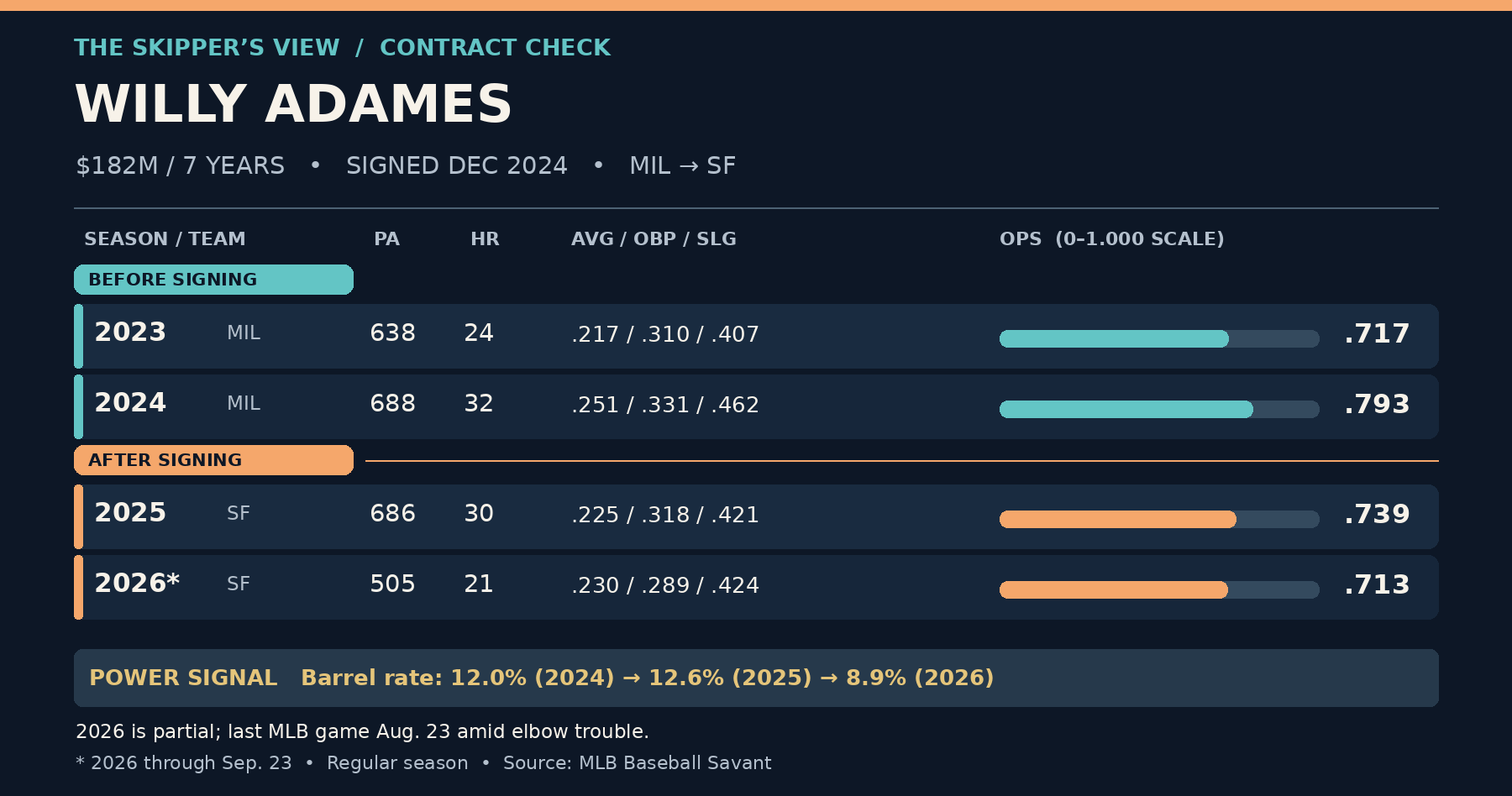
When the Vladdy video came out, Giants fans started chiming in talking about Willy Adames. Similar to Santander, Willy’s 2023 season was mediocre, followed by a Top 10 MVP finish in 2024. He also had some solid seasons prior, which is where we get into the “paid for what we have done” argument.
San Francisco signed him that December of 2024. In his first Giants year, he hit 30 homers in 686 PA. Yes, his OPS fell back to .739, but his barrel rate rose from 12.0% to 12.6%. While his bWAR was also up, all his offensive categories took a dip. Remember, this was the first year of a 7-year deal.
His second year gives the Giants a real concern: 21 homers and a .713 OPS in 505 PA, with his barrel rate down to 8.9% and expected slugging down from .435 to .391. In his age-30 season, injuries began to pile up, and we have not seen Adames on the field since August.
The Giants have Chapman, Devers, and Adames all on big contracts. None are living up to their potential, but Adames stands out amongst the three.
Xander Bogaerts — $280 million, 11 years
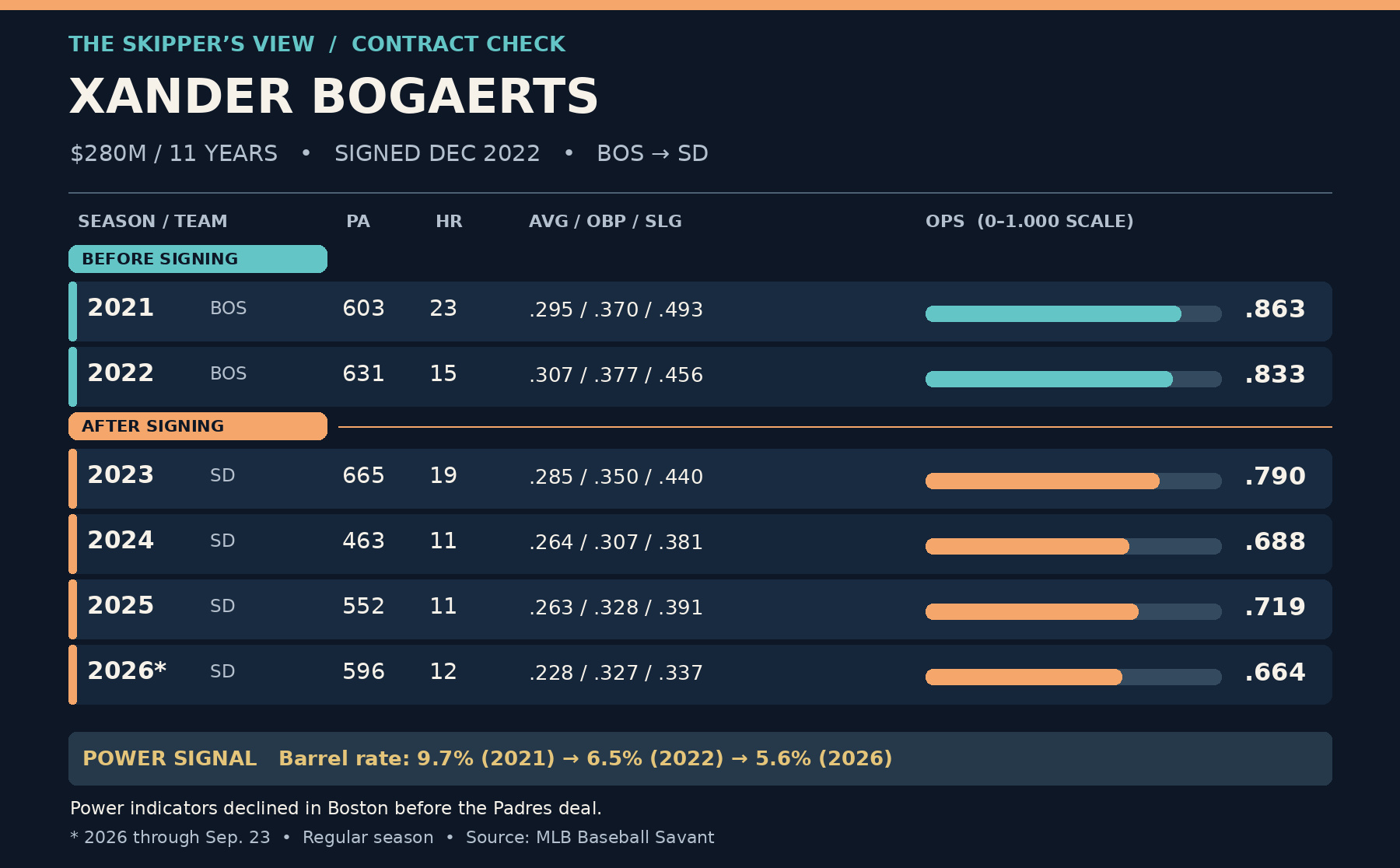
This one stings, because I really wanted Xander to succeed after he left the Red Sox. He finished his last two years in Boston with a .863 and .833 OPS. Pretty solid for a shortstop.
San Diego responded with a massive $280 million deal over 11 years. His Padres OPS has gone .790, .688, .719, .664. This current season includes just 12 homers in 596 PA. His barrel rate fell from 9.7% in 2021 to 6.5% in 2022 before San Diego signed him; it is 5.6% in 2026.
Javier Báez — $140 million, six years
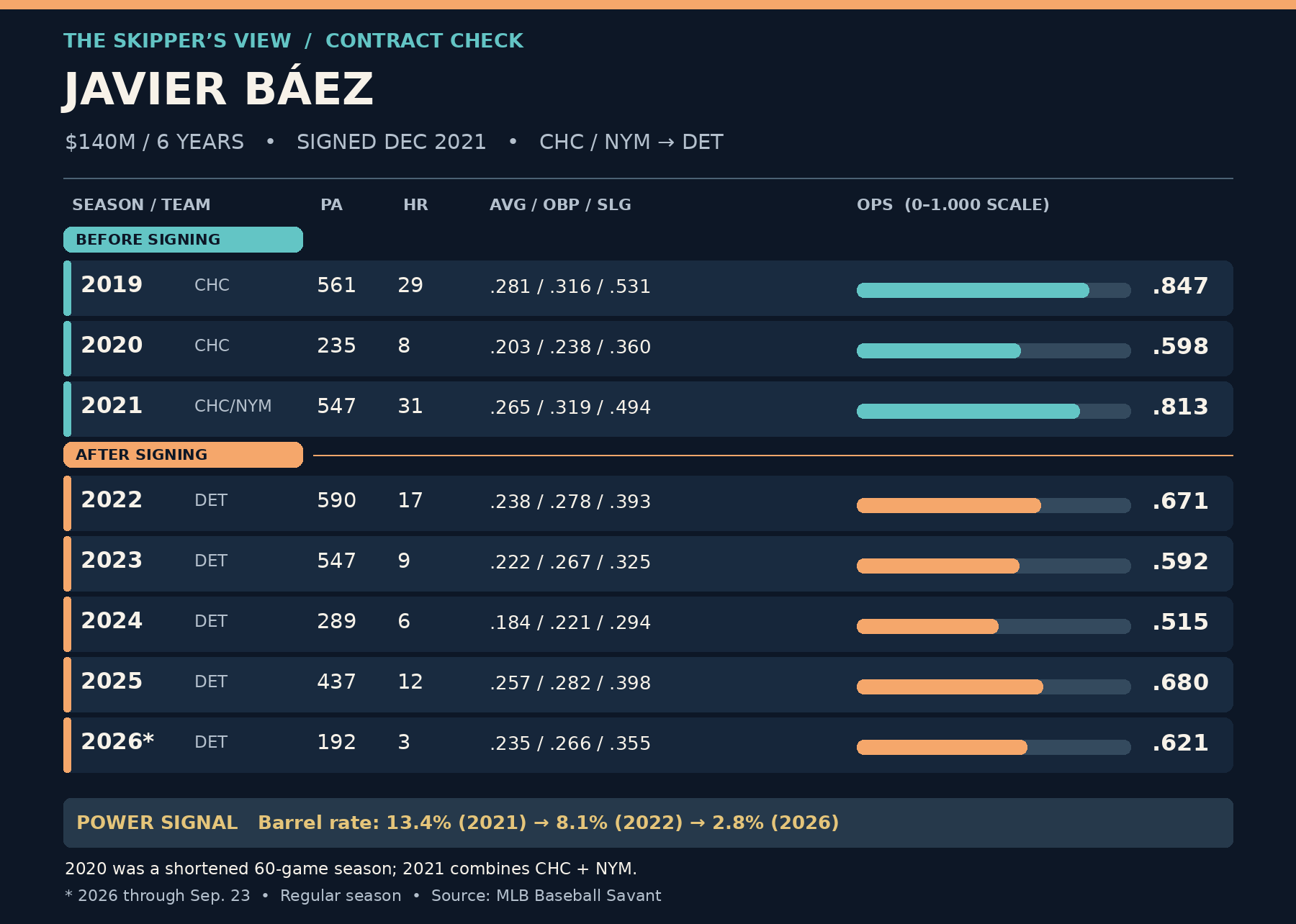
The Javier Báez trade and then signing will go down as one of the worst in MLB history. Friendly reminder: the Mets sent Pete Crow-Armstrong to Chicago for Javier.
As for the contract, it fell apart immediately. He hit 29 homers with a .847 OPS in 2019 and 31 with a .813 OPS in 2021, before signing with Detroit. From 2022 through 2024, his OPS went .671 → .592 → .515. His chase rate was already an extreme 44.6% in 2021, before the deal; it did not begin in Detroit.
Lucky for Detroit, they will be out of this contract after next season.
José Abreu — $58.5 million, three years
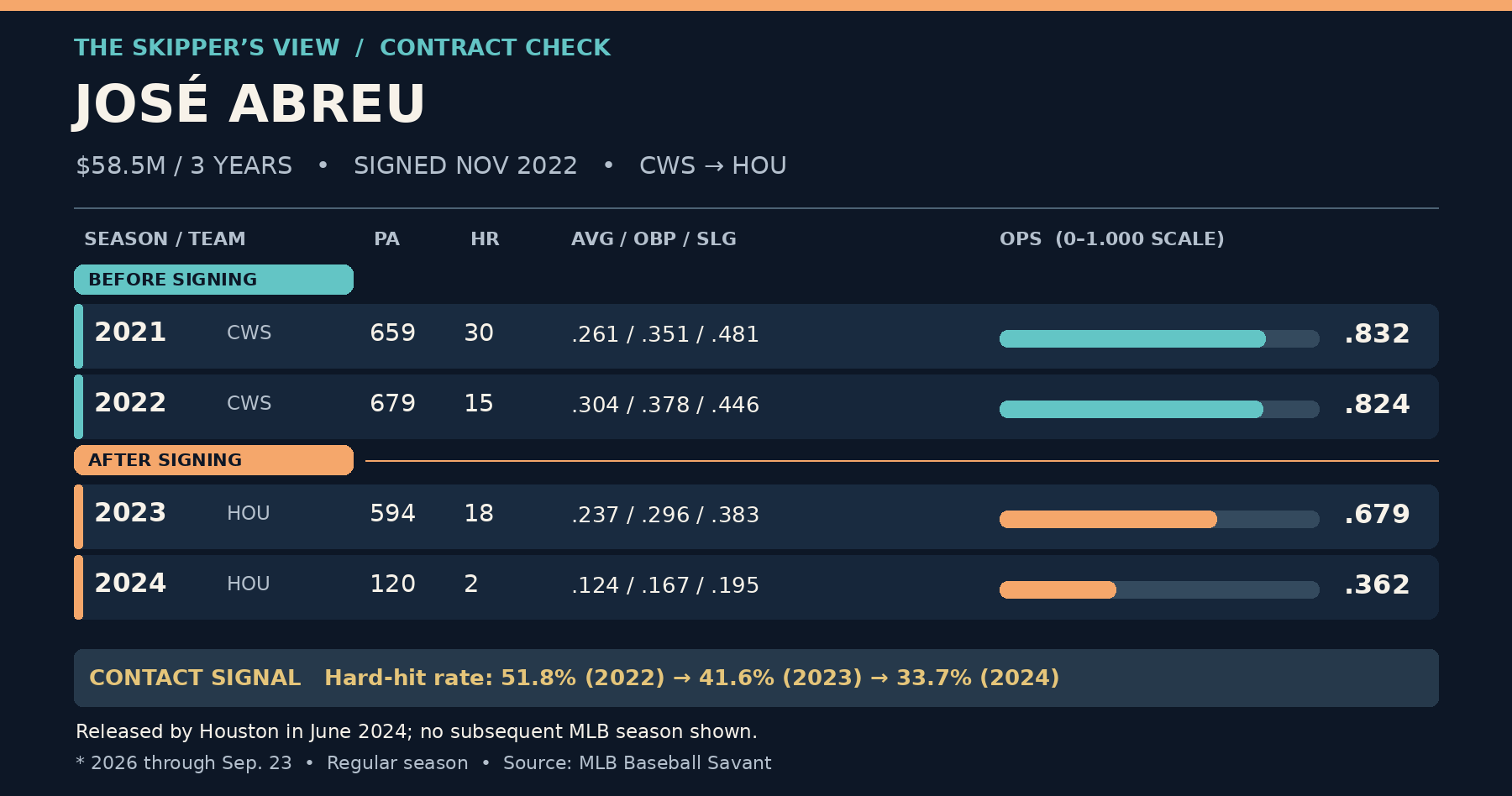
Abreu is the shortest and sharpest fall, in large part because of his age. His last two White Sox seasons were .832 OPS with 30 homers in 2021 and .824 OPS with 15 homers in 2022. Houston signed him heading into his age-36 season. He gave the Astros a .679 OPS and 18 homers in 2023, then a .362 OPS and two homers in 120 PA in 2024.
The underlying contact went off a cliff: average exit velocity 92.2 mph in 2022 → 89.0 → 87.8; hard-hit rate 51.8% → 41.6% → 33.7%. When the Astros sent him to the minors to work on his swing, he agreed to the assignment. GM Dana Brown described it as a sign of his dedication and commitment; Jeff Bagwell said, “It wasn’t without effort.”
This one is probably more a case of age just catching up with him, but still, a very steep drop-off.
Julio Rodríguez — the deal that tests the premise
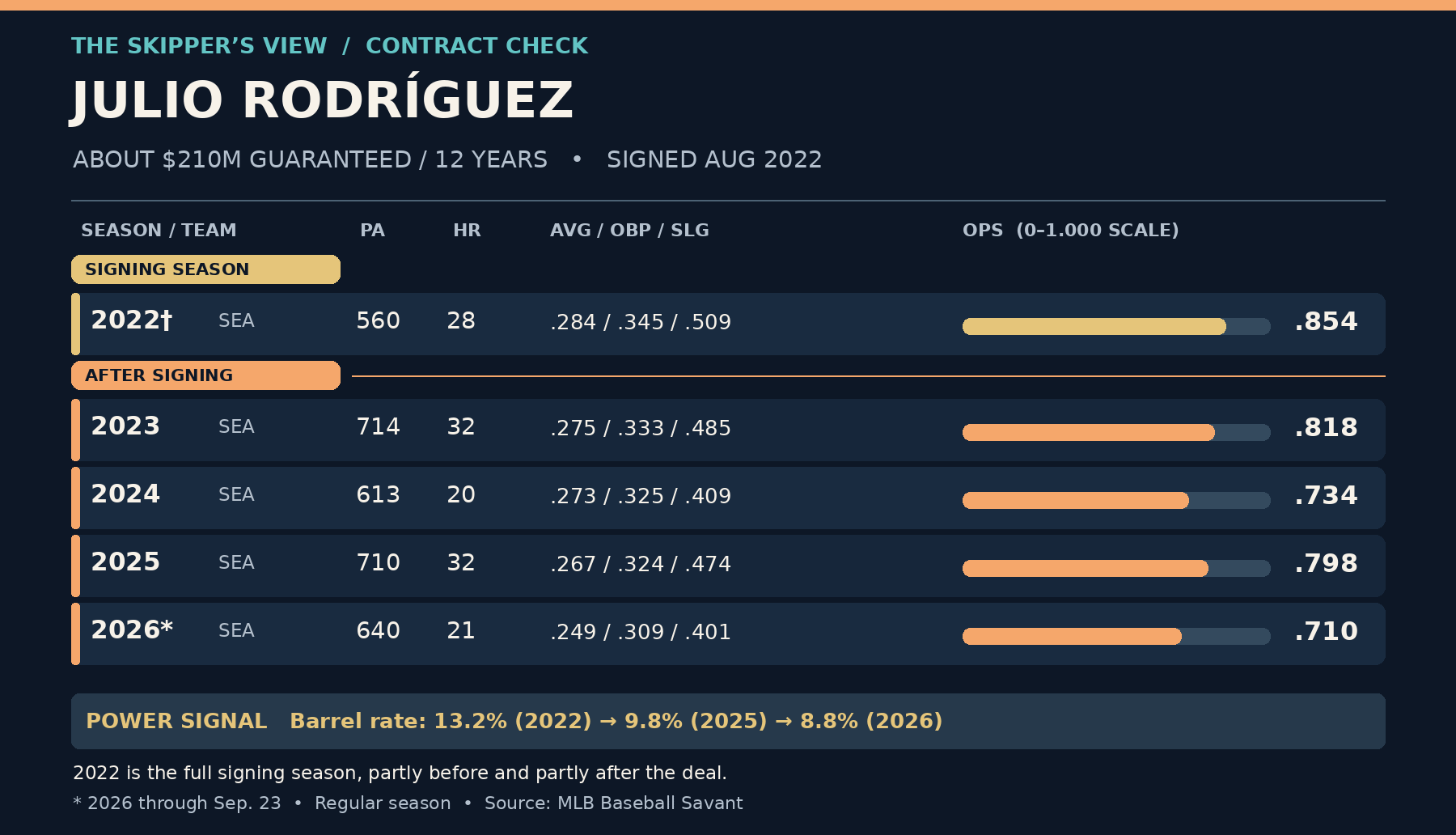
This entry is primarily to annoy my partner Brett. However, it is hard to argue that Julio hasn’t regressed since signing his contract a few years ago.
Sure, he has gone 20/20 all five seasons. Personally, I don’t think that’s overly impressive in today's game. His barrel rate has moved from 13.2% in his 2022 rookie season to 8.8% in 2026, and expected slugging has dropped from .473 to .439.
His chase rate has risen from 33.5% in 2022 to 38.5% in 2026. The league average is 28.6%. His OAA went from as high as 11 to -3 in 2026.
This one is a stretch, I know, but I believe it is worth keeping an eye on.