


Editor’s Note: Most of this blog was written almost a year ago. I put it on the back burner and waited until Bonds was up or the Hall of Fame again.
I am going to start this blog off with a very dark take. All the current BBWAA writers who vote on the Hall of Fame are going to be dead in the next few decades. Why is that relevant? Because a very high percentage of young fans (ages 14-30) believe that Bonds should be in the Hall of Fame. So, who will take their place when these current writers move on into the great beyond? Well, the current generation that wants to see Bonds in the Hall.
The only way Bonds could get in is from the committees. (like the one this Sunday)
As I scrolled through X this morning, planning my day of carrying The Skippers View on my back, I came across a post I had been tagged in.
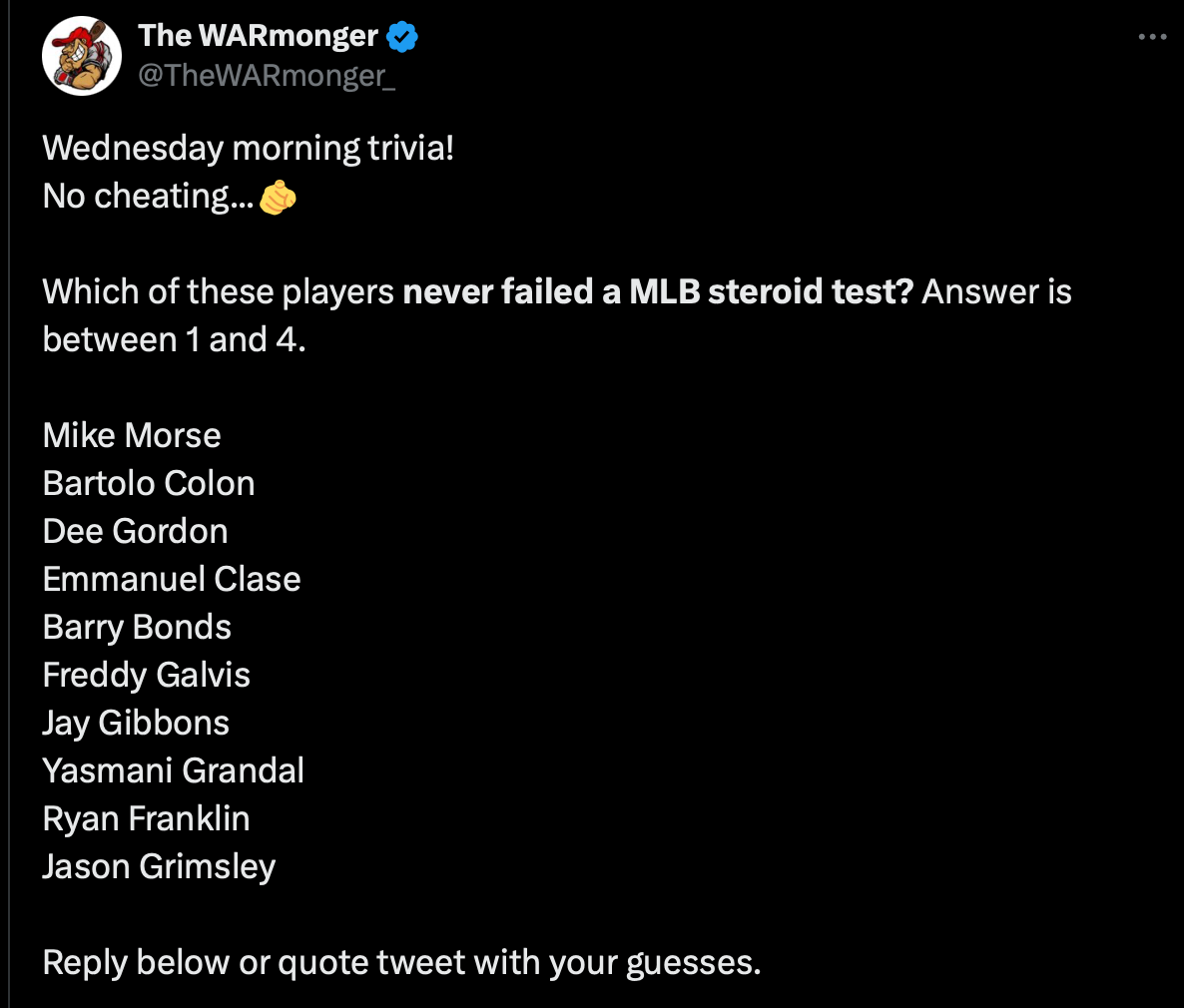
You can probably guess that Barry Bonds was the only player on this list never to fail a steroid test.
Barry Bonds stands as one of the most statistically dominant figures in the history of Major League Baseball. Holding the all-time home run record with 762 career blasts, seven MVP awards, a single-season home run record of 73, and numerous other records, his numbers in the early 2000s were only matched in my MLB The Show Franchise. His exclusion from the hall is due to a combination of performance-enhancing drug allegations and a reputation that polarized fans, writers, and baseball authorities alike. (he was kind of a d***)
While other players from the steroid era have found a measure of acceptance, Bonds remains one of the most contentious figures in Hall of Fame eligibility.
Look, I am not a Barry Bonds guy. I am vehemently against cheating in any way, and for me, he should be barred from Cooperstown for life. But I understand that people want him in. So, let’s look at Bonds BEFORE he cheated.
First, what is it about Bonds' achievements PRE-STEROIDS that makes his Hall of Fame case so compelling? Second, we’ll examine the media’s role in shaping his legacy: did Bonds’s strained relationship with the press and his portrayal as a villain play a part in keeping him out of the Hall?
HOF Career Before Steroids
Even without accounting for his later accomplishments, Barry Bonds’ pre-1998 career stands on its own as Hall of Fame-caliber. By that year, he had already secured three MVP awards. His early career also saw him accumulate almost 400 home runs, over 400 stolen bases, seven Gold Glove awards, and seven Silver Sluggers. Bonds wasn’t simply a power hitter; he was a five-tool player.
I used Stathead to see where Bonds would rank All-Time if he had retired after the 1997 season at age 32. Here they are.
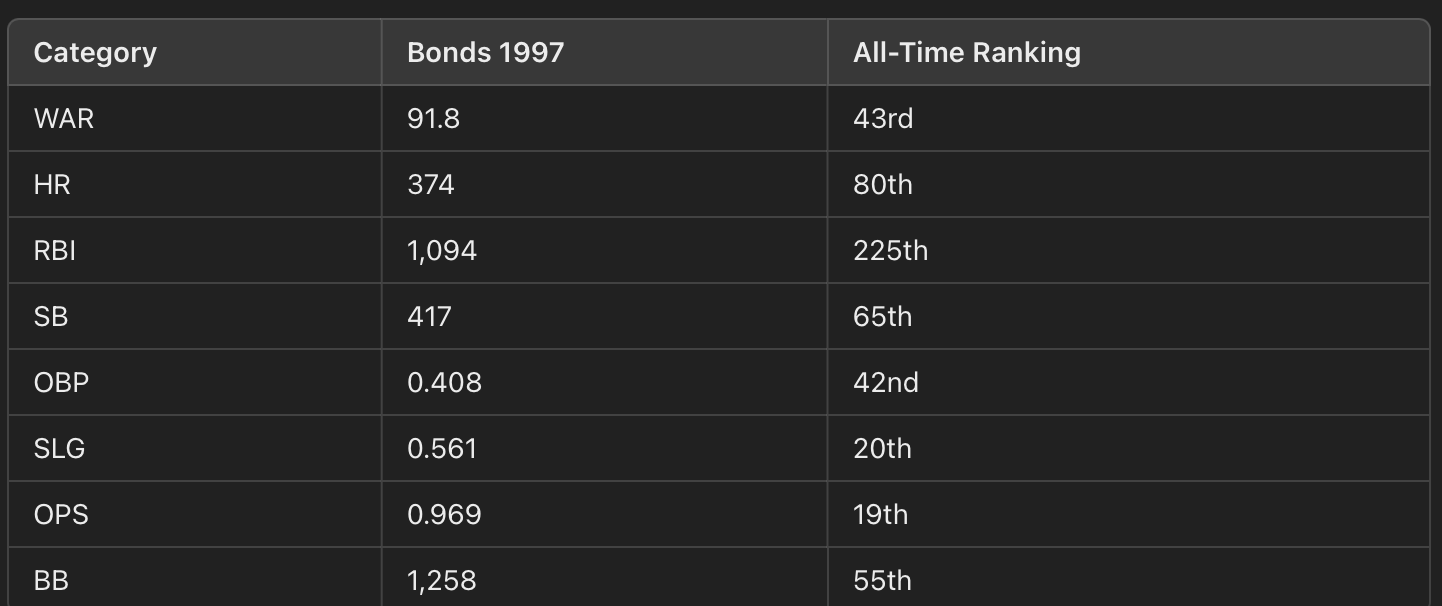
Do these numbers give “Greatest Player Ever” vibes? No, and that was the problem for Bonds; he wanted to be the greatest player of all time and could not deal with the fact that other players in the 90s were getting more attention than he was. Which is crazy, because he was like Mike Trout. A super dominant all-around player who was considered the best of his generation. Below are both players’ stats over their first twelve seasons.
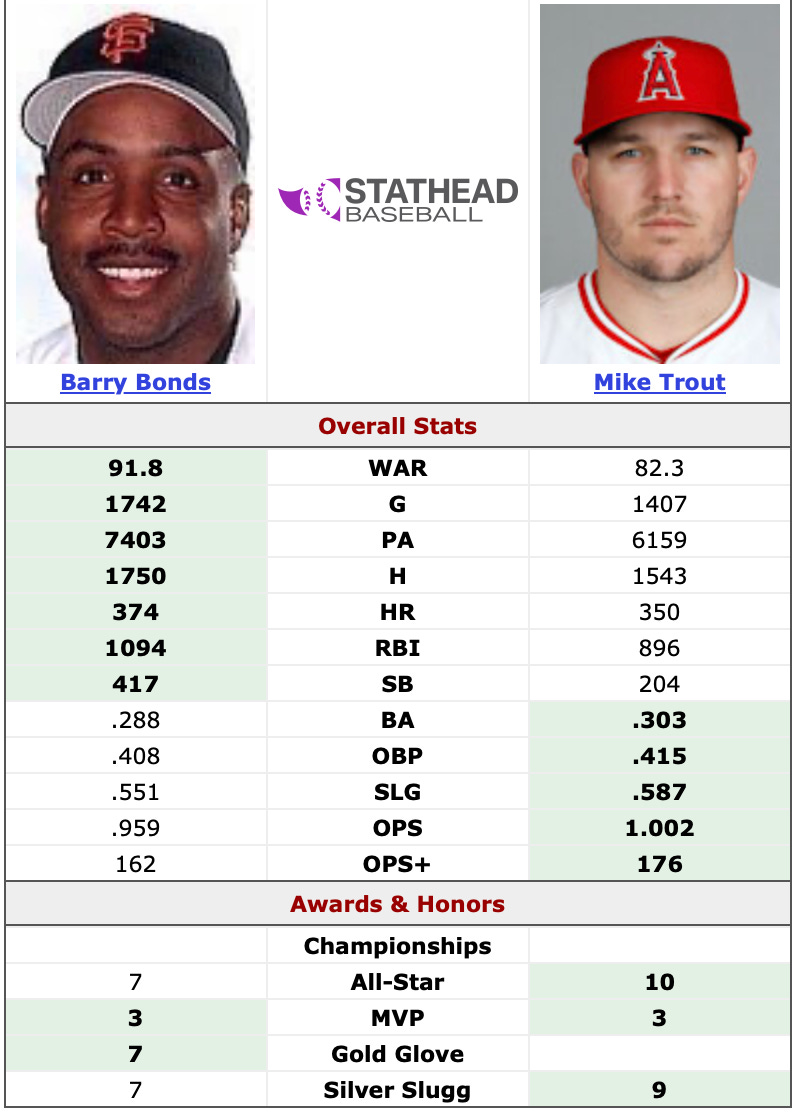
The majority of baseball fans, outside Yankee fans, consider Trout the greatest player of his generation. Now, Ohtani has come in and taken that mantle, but it does not take away how dominant Mike Trout was for the 2010s
That is what Bonds could have done. Play a few more productive years, reach 2,000 hits, 500 home runs, and maybe squeak out 500 stolen bases. He would have gone down as a Top 50 player of all time and could have had a plaque in Cooperstown right now. Instead, he decided to cheat and lie his way to the finish line. But it was at a time when PEDs were rampant.
During this period, PEDs were both a prominent and largely unregulated part of the game. Testing policies were inconsistent, and the league’s stance on drug use was ambiguous at best. Bonds’ name has become synonymous with the “Steroid Era,” yet he was never officially suspended for PED use.
Importantly, several players from Bonds’ era, some of whom have admitted to PED use, have still received honors and are celebrated by fans. This selective scrutiny raises questions about fairness and consistency. Bonds, despite being a symbol of the steroid era, did not define it alone, and many believe he is being unfairly punished for a culture that involved numerous players and persisted unchecked by MLB.
That brings us to the second reason Bonds has been shut out.
He was a d**k.
Going From A D**K To Relatable Grandpa
Throughout his career, Barry Bonds’ relationship with the media was notoriously strained, a dynamic that significantly impacted his public image and ultimately shaped his legacy. Unlike many of his contemporaries, Bonds was often resistant to the media's demands, famously avoiding interviews and pushing back against journalists’ scrutiny. This tension created an adversarial relationship that persisted for years. While Bonds’ reluctance to engage with the press was a personal choice, it had long-term consequences that continue to influence how he’s remembered.
You can make the argument that he could have won up to three more MVPs if he weren’t so hated by the media. He was robbed in 1991 and 2000, coming in 2nd both years. In 1996 and 1998, he led the league in WAR but finished 5th and 8th, respectively. In 1995, he led all NL hitters in WAR with 7.5 bWAR and placed 12th in MVP voting!!!
Yes, it was a different time when writers prioritized team success over individual success. However, the writers did not hide their distaste for Bonds, and he did not hide their distaste for them. But again, harkening back to my opening paragraph. These writers are dying (sorry), and a new generation is coming in—a generation that doesn’t care about PEDs, unwritten rules, or Bonds being cranky with reporters.
And guess what, Bonds knows that.
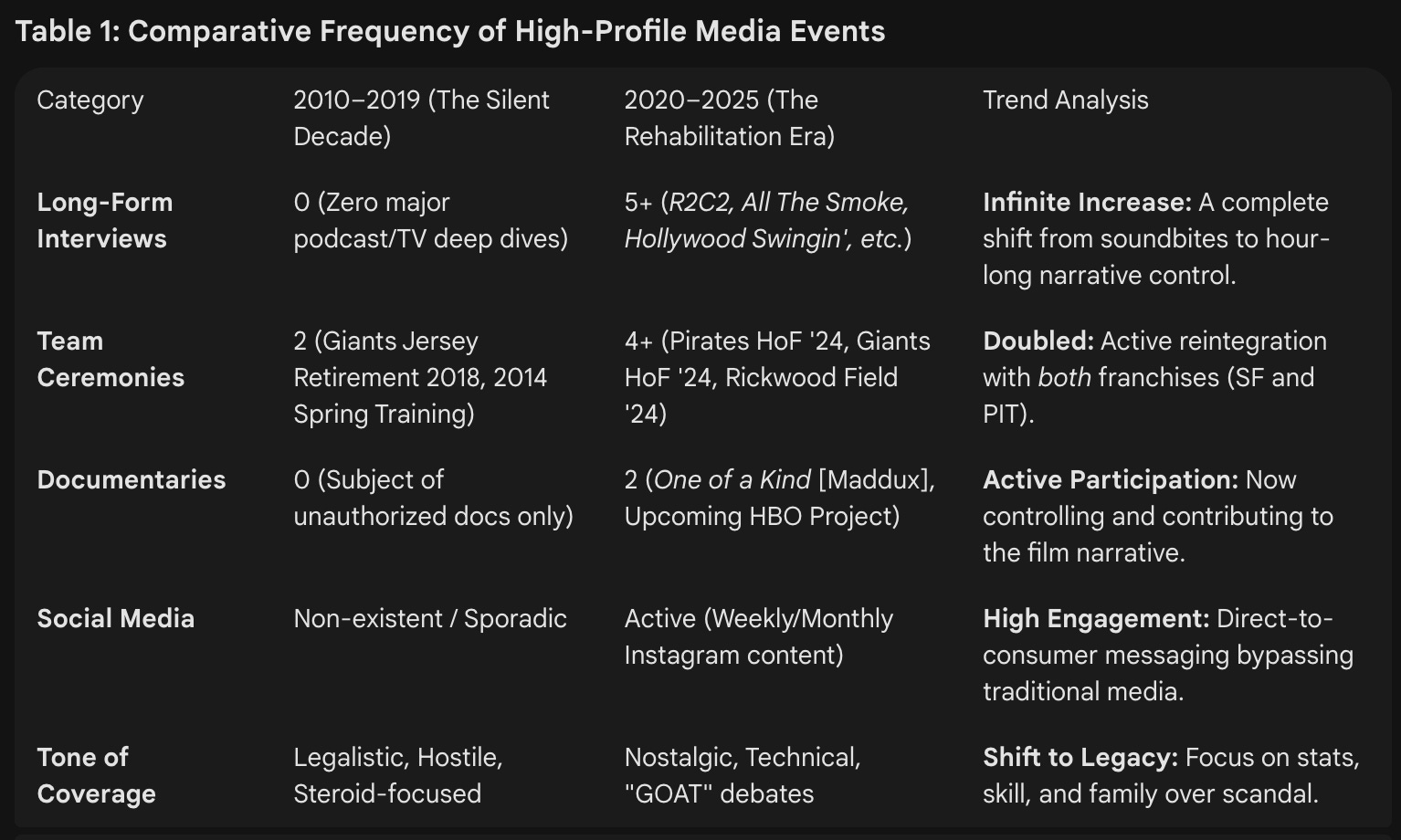
Over the last five years, it has been impossible not to notice the increase in Barry Bonds’ appearances across baseball media. A big reason for that is that Bonds doesn’t have to talk to reporters; he gets to speak to former players who are hosting their own podcasts. And, well, he doesn’t hold back. He has called out the sport multiple times for excluding him when he was never convicted or failed any tests. The men interviewing them all nod in agreement and throw more praise on Barry.
For the generation of new fans growing up, they are never going to see the cranky Bonds from his playing days. They know the guy on podcasts who, I will admit, is super passionate and articulate about how great baseball is. They see the man on social media posting photos with his dogs and grandkids. Bonds knows what he is doing. Just take a look at this chart.
The team working on his documentary is the same one that did Last Dance. Whether you like it or not, The Last Dance woke up an entire generation to Michael Jordan’s greatness. Sure, you still have some people like Brett who think that because LeBron has more points (stat padding), Jordan is no longer the GOAT. But most sane people who watch that documentary come out feeling reminded of what is most important… Winning.
Final Thoughts
Obviously, that documentary isn’t going to save Bonds this year. I think the chances of him getting elected this year are next to zero, but he needs five votes to make the next ballot. I think he will get those. That will give him another two years to continue fixing his reputation. In my opinion, Bonds needs to stay on the ballot long enough for the generation of players and executives who are hardline against cheaters to die, and he will get in.
Unfortunately, my generation is the “participation trophy generation.” So most people my age (and their parents who were handing out the trophy) aren’t bothered by the cheating. That is now being passed down to the TikTok generation that Bonds is beginning to tap into. He and his team know what they are doing, and they will win the public's support. When there is enough noise, Cooperstown will bow down.
If you haven’t already, please consider subscribing below!