


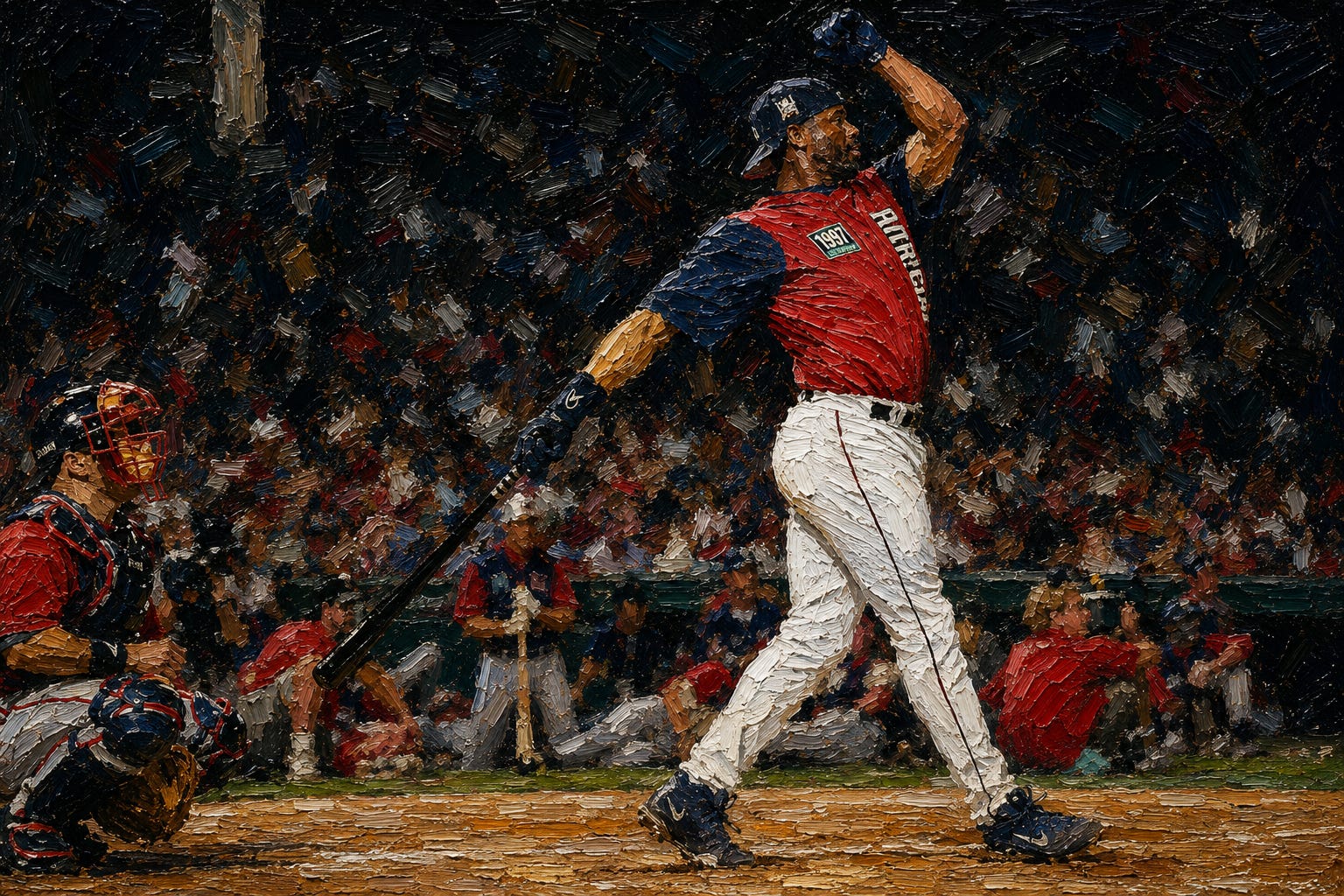
The Home Run Derby is about as American as Apple Pie. For the past 40+ years, some of Major League Baseball’s best sluggers have gathered before the All-Star Game to hit absolute bombs in an effort to crown the best home run hitter of that season. The Home Run Derby has produced many iconic moments and even more iconic winners. Ken Griffey Jr, Barry Bonds, David Ortiz, and Prince Fielder are just a few of the legendary players to win the coveted Home Run Derby trophy.
Unfortunately, not all champions are created equally, and while there really hasn’t been a “bad” player who has won the derby, there certainly have been some winners whose career statistics do not come close to the pedigree of Bonds or Junior.
I tasked myself with the difficult challenge of ranking all 28 unique (non-active) Home Run Derby Champions based on their overall career achievements and statistics.
Important note: these rankings are subjective and based on my opinion.
28. Wally Joyner (1986 Co-Champion)
The former California Angels first baseman was the co-champion of just the second Home Run Derby in MLB history. Ironically, 1986 was Joyner’s rookie season and also his first and only All-Star appearance. Ranking him last speaks more to the strength of the Derby’s winners than it does to Joyner’s career. Across 16 seasons, he collected more than 2,000 hits, hit 204 home runs, posted a .289 career batting average, and was a dependable middle-of-the-order hitter for over a decade.
27. Todd Frazier (2015 Champion)
“The Toddfather” enjoyed one of the best peaks of any power hitter during the mid-2010s. From 2012 through 2016, Frazier averaged 28 home runs per season, earned three consecutive All-Star selections, won a Gold Glove, and accumulated more than 17 WAR. His career tailed off after age 30, preventing him from building the longevity needed to climb this list, but his unforgettable hometown victory at Cincinnati’s Great American Ball Park remains one of the most memorable Home Run Derby performances ever.
26. Ruben Sierra (1989 Co-Champion)
Ruben Sierra often gets overlooked when discussing the stars of the late 1980s and early 1990s, but he quietly put together an impressive 20-year career. A four-time All-Star and Silver Slugger winner, Sierra finished with 306 home runs, over 2,100 hits, and nearly 1,300 RBIs. He was one of the American League’s premier run producers during his peak with the Rangers, even finishing second in AL MVP voting in 1989. While he lacks the accolades of many players ahead of him, Sierra’s longevity and consistent production keep him comfortably ahead of the bottom two.
25. Yoenis Cespedes (2014 & 2015 Champion)
Few players embodied raw power quite like Yoenis Céspedes. His back-to-back Home Run Derby victories remain one of the event’s most entertaining stretches, and at his peak, he was among baseball’s most exciting hitters. However, injuries significantly shortened what appeared to be a potentially great career. Despite finishing with only 165 career home runs across eight MLB seasons, Cespedes was a two-time All-Star, Gold Glove winner, and key contributor to the Mets’ 2015 National League pennant. His spectacular peak earns him a spot above the bottom tier, but his lack of longevity prevents him from climbing much higher.
24. Garrett Anderson (2003 Champion)
One of the most underrated hitters of the 2000s, Garrett Anderson spent 15 seasons with the Angels and became one of the franchise’s all-time greats. A three-time All-Star, Anderson amassed more than 2,500 hits, 287 home runs, and over 1,300 RBIs while playing a major role on the Angels’ 2002 World Series championship team. His consistency and longevity make him one of the stronger players in the bottom half of this ranking, even if he never reached true superstar status.
23. Tino Martinez (1997 Champion)
Tino Martinez will forever be remembered as the first baseman who helped bridge the Yankees from the Don Mattingly era into their late-1990s dynasty. Although he was never considered one of the game’s elite individual stars, Martinez compiled an outstanding career that included 339 home runs, over 1,200 RBIs, two All-Star appearances, and four World Series championships. His postseason résumé is among the best on this list, but compared to the players ranked above him, he falls a bit short in terms of individual accolades
22. Eric Davis (1989 Co-Champion)
At his peak, Eric Davis looked destined for Cooperstown. A dynamic five-tool player, Davis combined elite power, speed, and defense in a way few players of his era could match. Unfortunately, injuries prevented him from ever putting together the sustained dominance many expected. Even so, Davis finished his 17-year career with 282 home runs, 349 stolen bases, three Gold Gloves, two Silver Slugger Awards, and nearly 37 bWAR.
21. Ryan Howard (2006 Champion)
Few players have ever reached the heights Ryan Howard did during his prime. From 2006 through 2009, Howard averaged nearly 50 home runs and 143 RBIs per season while winning National League Rookie of the Year, MVP, and helping lead the Phillies to the 2008 World Series title. His production fell dramatically after injuries, particularly a torn Achilles tendon in 2011, shortened his peak. Despite finishing with 382 career home runs, Howard’s relatively short period of elite play keeps him toward the bottom half of this ranking.
20. Darryl Strawberry (1986 Co-Champion)
Darryl Strawberry possessed Hall of Fame talent and, for much of the 1980s, played like one of baseball’s biggest stars. An eight-time All-Star, four-time World Series champion, and National League Rookie of the Year, Strawberry blasted 335 career home runs despite numerous injuries and off-field struggles that shortened his career. His combination of power and postseason success places him ahead of several players with longer careers.
19. Justin Morneau (2008 Champion)
Justin Morneau was one of the American League’s premier hitters during the mid-2000s. The Canadian slugger won the 2006 AL MVP Award, made four All-Star teams, won two Silver Sluggers, and finished with 247 home runs and a .281 career batting average. A series of concussions, unfortunately, derailed what appeared to be a Hall of Fame trajectory, but Morneau still enjoyed an outstanding 14-year career.
18. Jason Giambi (2002 Champion)
Jason Giambi was one of baseball’s most feared hitters during the late 1990s and early 2000s. The 2000 AL MVP reached base at an elite rate throughout his career, finishing with 440 home runs, over 2,000 hits, and a .399 career on-base percentage. While PED allegations have clouded his legacy and likely kept him out of Hall of Fame consideration, Giambi’s offensive production alone earns him a solid middle-of-the-pack ranking.
17. Miguel Tejada (2004 Champion)
Miguel Tejada built one of the most consistent careers of any infielder in recent history. The six-time All-Star won the 2002 American League MVP Award, collected over 2,400 hits, hit 307 home runs, drove in more than 1,300 runs, and played in an incredible 1,152 consecutive games. While PED ties have also impacted his legacy, Tejada remains one of the best offensive shortstops of his generation.
16. Luis Gonzalez (2001 Champion)
Luis Gonzalez enjoyed one of the finest late-career breakouts in baseball history. Best remembered for his walk-off single that won Game 7 of the 2001 World Series, Gonzalez finished with 354 home runs, over 2,500 hits, five All-Star selections, and five Gold Gloves. Although much of his production came after age 30, his longevity and postseason heroics give him the edge over those ranked below him.
15. Dave Parker (1985 Champion)
Nicknamed “The Cobra,” Dave Parker was one of baseball’s most complete players during the late 1970s and early 1980s. The seven-time All-Star won the 1978 National League MVP, captured three Gold Gloves and three Silver Sluggers, and finished with 339 home runs and over 2,700 hits. Parker also won two World Series championships and was finally elected to the Hall of Fame by the Classic Baseball Era Committee after his playing career.
14. Juan Gonzalez (1993 Champion)
Few hitters were more intimidating during the 1990s than Juan Gonzalez. The Rangers slugger won two American League MVP Awards, led the league in RBIs three times, and blasted 434 career home runs despite playing only 17 seasons. Injuries shortened what could have been an even greater career, and his PED-era reputation has complicated his legacy, but his offensive peak remains among the best on this list.
13. Prince Fielder (2009 & 2012 Champion)
Like his father, Cecil, Prince Fielder became one of baseball’s premier power hitters. The six-time All-Star hit 319 home runs, drove in over 1,000 runs, won three Silver Sluggers, and twice claimed the Home Run Derby crown. A neck injury forced Fielder to retire at just 32 years old, cutting short what appeared to be a path toward 500 career home runs.
12. Bobby Abreu (2005 Champion)
Bobby Abreu may be one of the most underrated players of his generation. The two-time All-Star combined power, speed, patience, and durability to produce over 2,400 hits, 288 home runs, 400 stolen bases, and nearly 60 bWAR. While he never won an MVP or reached the Hall of Fame, Abreu’s all-around game and remarkable consistency make him one of the strongest resumes outside the top ten.
11. Robinson Cano (2011 Champion)
At his peak, Robinson Cano was regarded as the best second baseman in baseball. An eight-time All-Star, five-time Silver Slugger, two-time Gold Glove winner, and 2009 World Series champion, Cano produced over 2,600 hits and 335 home runs. However, two PED suspensions significantly damaged what otherwise looked like a certain Hall of Fame career.
10. Ryne Sandberg (1990 Champion)
One of the greatest second basemen in baseball history, Ryne Sandberg, revolutionized the position with his combination of power and defense. The 1984 National League MVP won nine Gold Gloves, seven Silver Sluggers, made ten All-Star teams, and finished with over 2,300 hits and 282 home runs. His Hall of Fame induction cemented his status as one of the all-time great infielders.
9. Andre Dawson (1987 Champion)
“The Hawk” was one of baseball’s premier five-tool stars throughout the 1980s. Dawson won the 1987 National League MVP, earned eight Gold Gloves, eight All-Star selections, and hit 438 career home runs while collecting over 2,700 hits. His combination of power, speed, and defense eventually earned him a well-deserved place in Cooperstown.
8. Mark McGwire (1992 Champion)
Mark McGwire forever changed baseball during the historic 1998 home run chase. One of the greatest pure power hitters ever, McGwire slugged 583 home runs while posting an astonishing .588 career slugging percentage. However, his admitted steroid use has complicated his legacy and prevented him from being elected to the Hall of Fame during his tenure on the ballot. Even so, few players in MLB history have matched his ability to hit baseballs farther or more frequently.
7. Frank Thomas (1995 Champion)
“The Big Hurt” was one of the most dangerous offensive players the game has ever seen. A two-time American League MVP and first-ballot Hall of Famer, Thomas finished with 521 home runs, over 2,400 hits, a .301 batting average, and an incredible .419 career on-base percentage. His combination of power, patience, and consistency made him one of the defining hitters of the 1990s.
6. Vladimir Guerrero (2007 Champion)
Vladimir Guerrero was one of the most electrifying all-around players that baseball has ever seen. Famous for crushing pitches well outside the strike zone, Guerrero collected 2,590 hits, 449 home runs, a career .318 batting average, and won the 2004 American League MVP Award. A nine-time All-Star and Hall of Famer, “Vladdy” combined tremendous power with one of the strongest throwing arms in baseball history.
5. Sammy Sosa (2000 Champion)
Sammy Sosa is responsible for one of the greatest power-hitting stretches in MLB history, becoming the only player ever to hit 60 or more home runs three times. The 1998 National League MVP finished his career with 609 home runs, over 1,600 RBIs, and seven All-Star appearances. While PED allegations have overshadowed his accomplishments, Sosa’s offensive production remains among the greatest ever.
4. David Ortiz (2010 Champion)
Few players have delivered in the biggest moments quite like David Ortiz. “Big Papi” hit 541 career home runs, made ten All-Star teams, won three World Series championships, and was named MVP of the 2013 World Series after carrying Boston through one of the most emotional seasons in franchise history. A first-ballot Hall of Famer, Ortiz is regarded almost universally as the greatest designated hitter in baseball history.
3. Cal Ripken Jr. (1991 Champion)
“The Iron Man” redefined durability while becoming one of the greatest shortstops ever to play the game. Ripken’s record streak of 2,632 consecutive games played may never be broken. Add in two AL MVP Awards, over 3,100 hits, 431 home runs, 19 All-Star selections, two Gold Gloves, and first-ballot Hall of Fame induction, and it’s easy to see why he ranks among baseball’s all-time legends.
2. Ken Griffey Jr. (1994, 1998, 1999 Champion)
No player is more synonymous with the Home Run Derby than Ken Griffey Jr. Junior’s signature backwards hat and sweet lefty swing resulted in an MLB record 3 Home Run Derby victories. Beyond the Derby, “The Kid” became one of baseball’s most beloved superstars, finishing with 630 home runs, ten Gold Gloves, an MVP Award, and 13 All-Star selections. Widely considered one of the greatest center fielders ever, Griffey was inducted into the Hall of Fame in 2016 with what was then the highest voting percentage in history.
1. Barry Bonds (1996 Champion)
No Home Run Derby champion can match the career accomplishments of Barry Bonds. The seven-time National League MVP remains MLB’s all-time home run king with 762 career home runs while also holding the single-season record with 73. Bonds won eight Gold Gloves, 12 Silver Sluggers, 14 All-Star selections, and finished with an astonishing 162.8 bWAR—the highest of any position player since Babe Ruth. Although his legacy remains deeply intertwined with performance-enhancing drug allegations, his statistical résumé is unparalleled, making him the clear choice for the top spot on this list and virtually any list ranking the greatest players in MLB history.
Hope you enjoyed. Please make sure to subscribe to the site for more articles coming soon!
Fnck Barry Bonds*.
Me: how is Josh Hamilton. It number 1b
Also me: oh…yeah. He lost.