


Yesterday, a story started to circulate about Paul Skenes. In short, he pointed to the World Baseball Classic as a potential factor in his velocity drop this season.
Paul Skenes threw 8 1/3 innings in the World Baseball Classic. That is 25 outs, two fewer than a complete game. Blaming a six-month decline on eight innings sounds like exactly the kind of excuse Skenes himself rejected before the tournament.
When workload concerns were raised before the WBC, Skenes told ESPN, “I think that’s an excuse. You can mitigate risk by working harder.”
Yikes. Six months later, and he sounds a little different.
Skenes told the Pittsburgh Post-Gazette, “There are a lot of other factors, so I don’t want to put everything on that.” He nevertheless called the WBC “kind of the root of it” and said it “definitely affected the year.”
There has been a lot of discussion over the last few years about having the WBC start before the season. A normal spring allows a pitcher to build velocity gradually, make mechanical corrections, and learn how his body is moving. Skenes had to accelerate that process for two “starts” in March after throwing a career-high 187 2/3 innings in 2025.
So sure, maybe this is a factor. But where does it compare to all the other pitchers who have competed in the WBC over the years? Well, I looked into it.
Let’s focus on Skenes first.
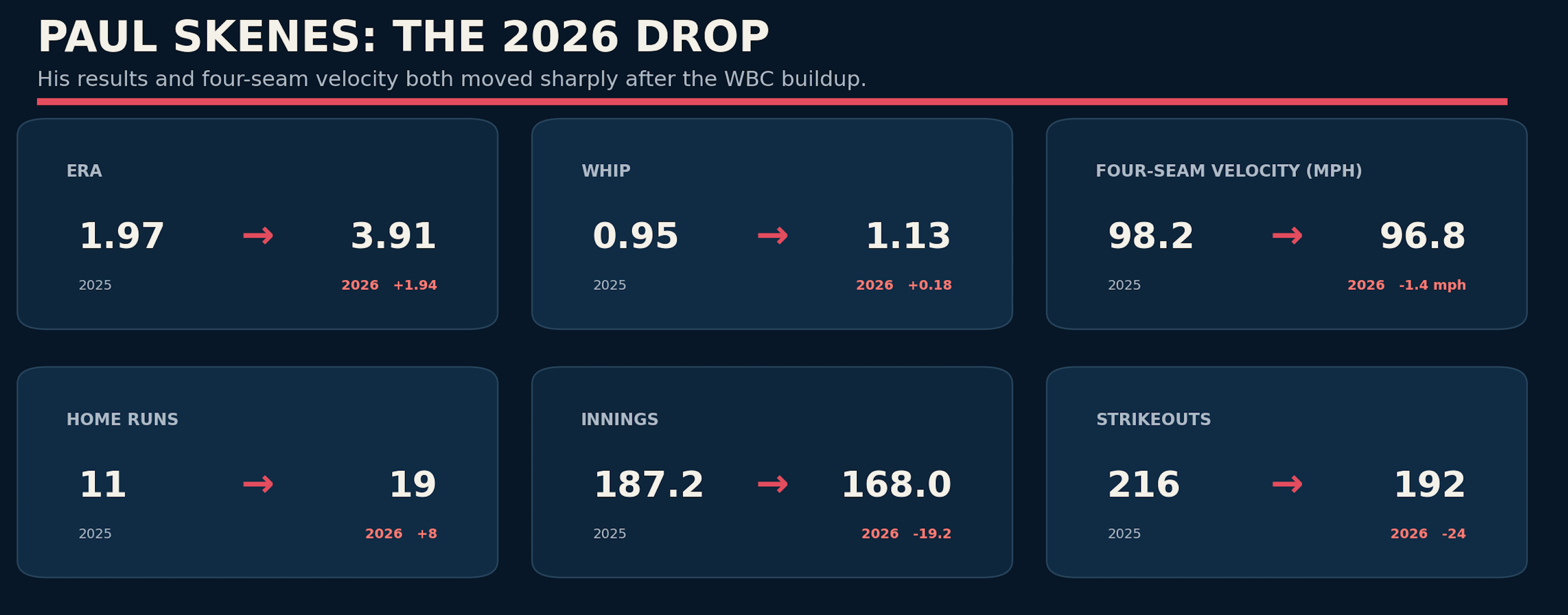
The velocity decline is the biggest red flag here. It is the catalyst for all the other stats regressing. Skenes lost 1.4 mph from his four-seam fastball in one year.
Now for the “expected” people out there. Skenes's xERA is 2.94, with his FIP being 3.32. I don’t
So how did other Team USA pitchers respond after carrying WBC workloads in March?
How the Comparison Works
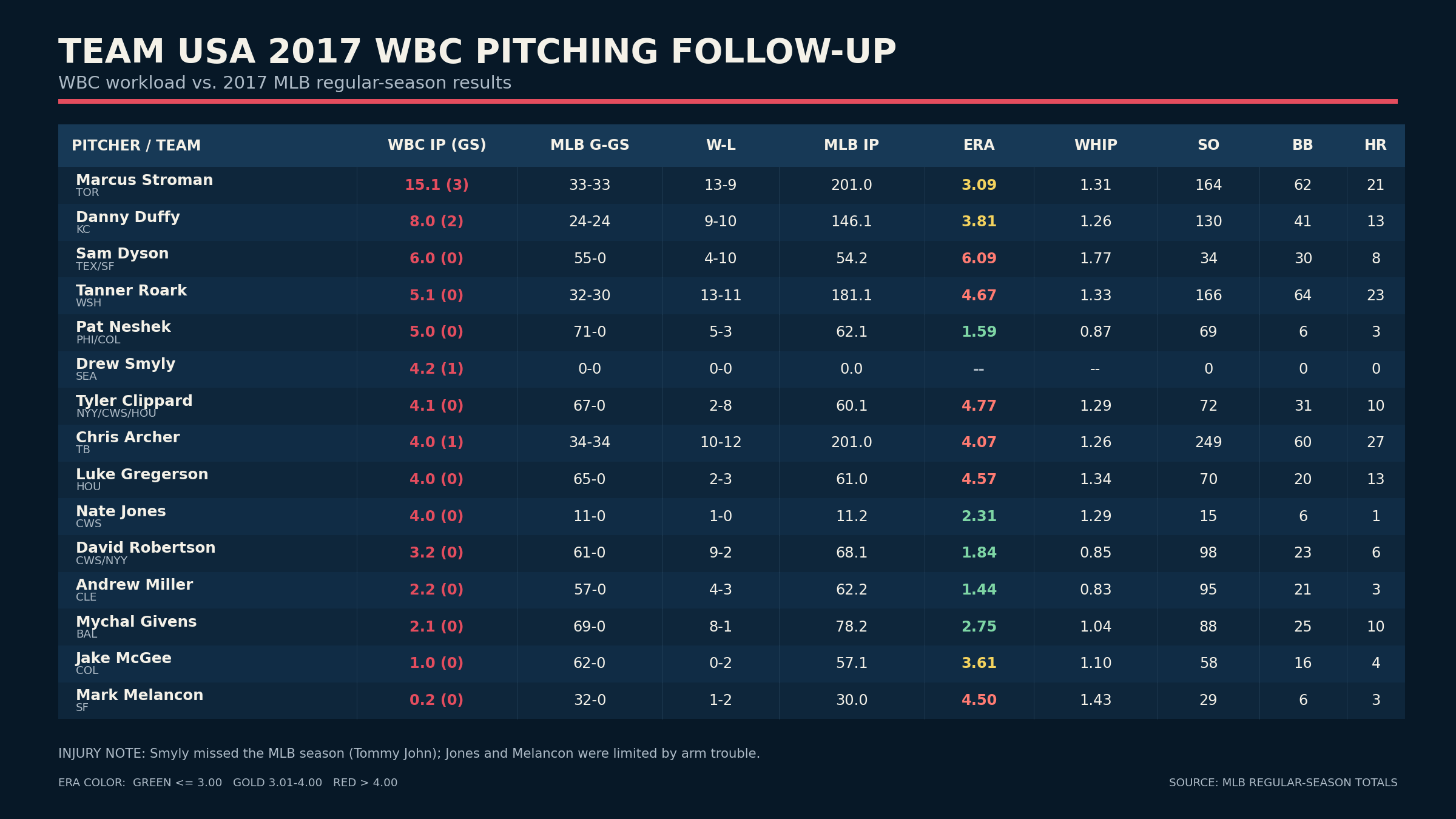
The following tables use each pitcher’s official WBC innings and his MLB regular-season line from that same calendar year.
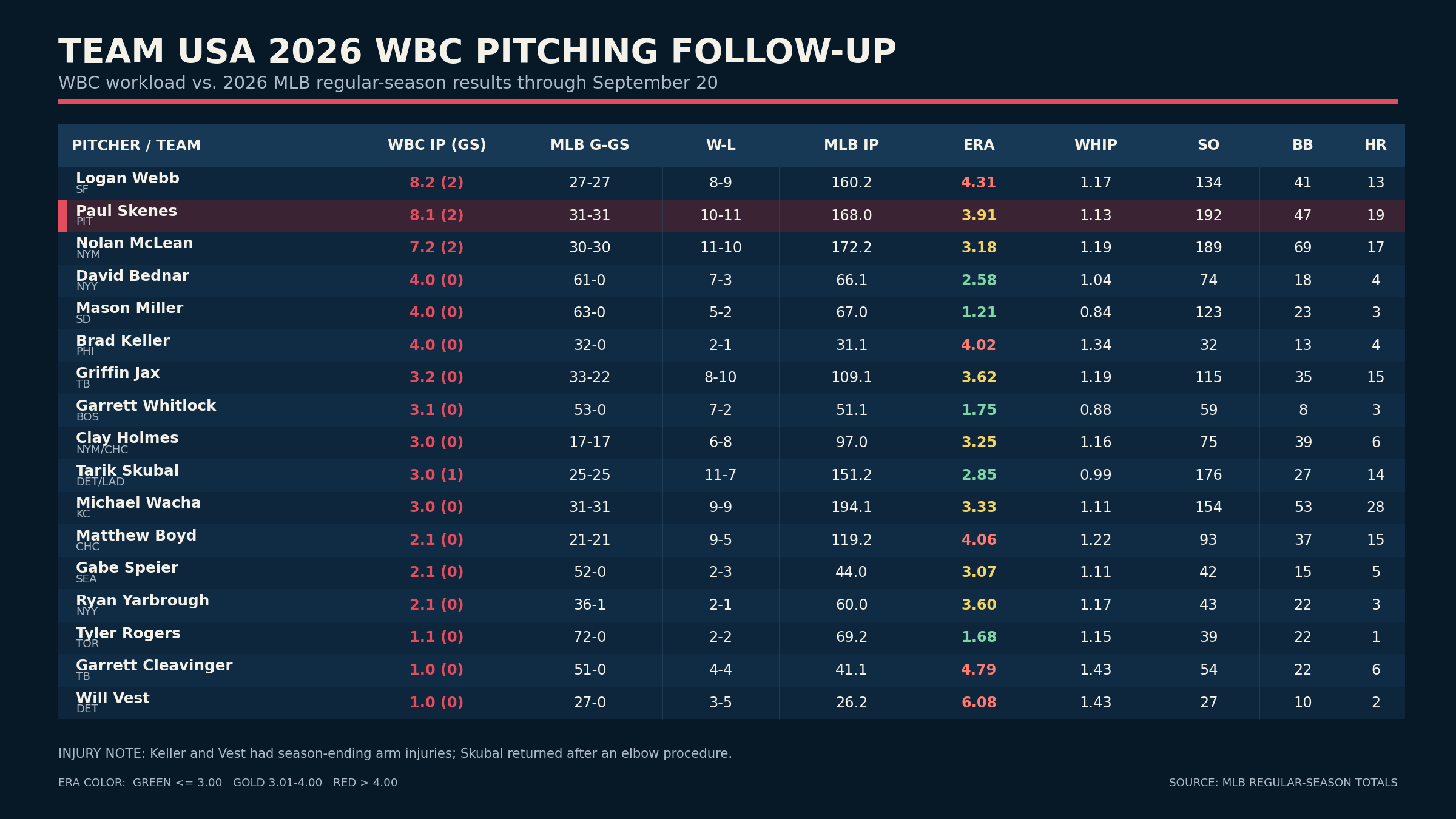
The 2026 numbers are through September 20 and are not final.
2017 Team USA
2017 Takeaways
Stroman carried the largest WBC workload in this study and then threw 201 innings with a 3.09 ERA. This is a huge improvement from his 2016 season, when he carried a 4.37 ERA.
The starting results were mixed. Duffy held up reasonably well, Archer reached 201 innings, and Roark reached 181 1/3, although Archer and Roark were less effective than Stroman.
The bullpen was generally excellent. Neshek, Robertson, Miller, Givens, and McGee all produced strong regular seasons.
Three pitchers had significant arm trouble. Smyly never appeared in an MLB game and underwent Tommy John surgery. Jones made only 11 appearances before season-ending elbow surgery. Melancon was limited to 32 games by a recurring pronator strain and underwent surgery in September. The timing is notable, but it does not establish that the WBC caused those injuries.
2023 Team USA
2023 Takeaways
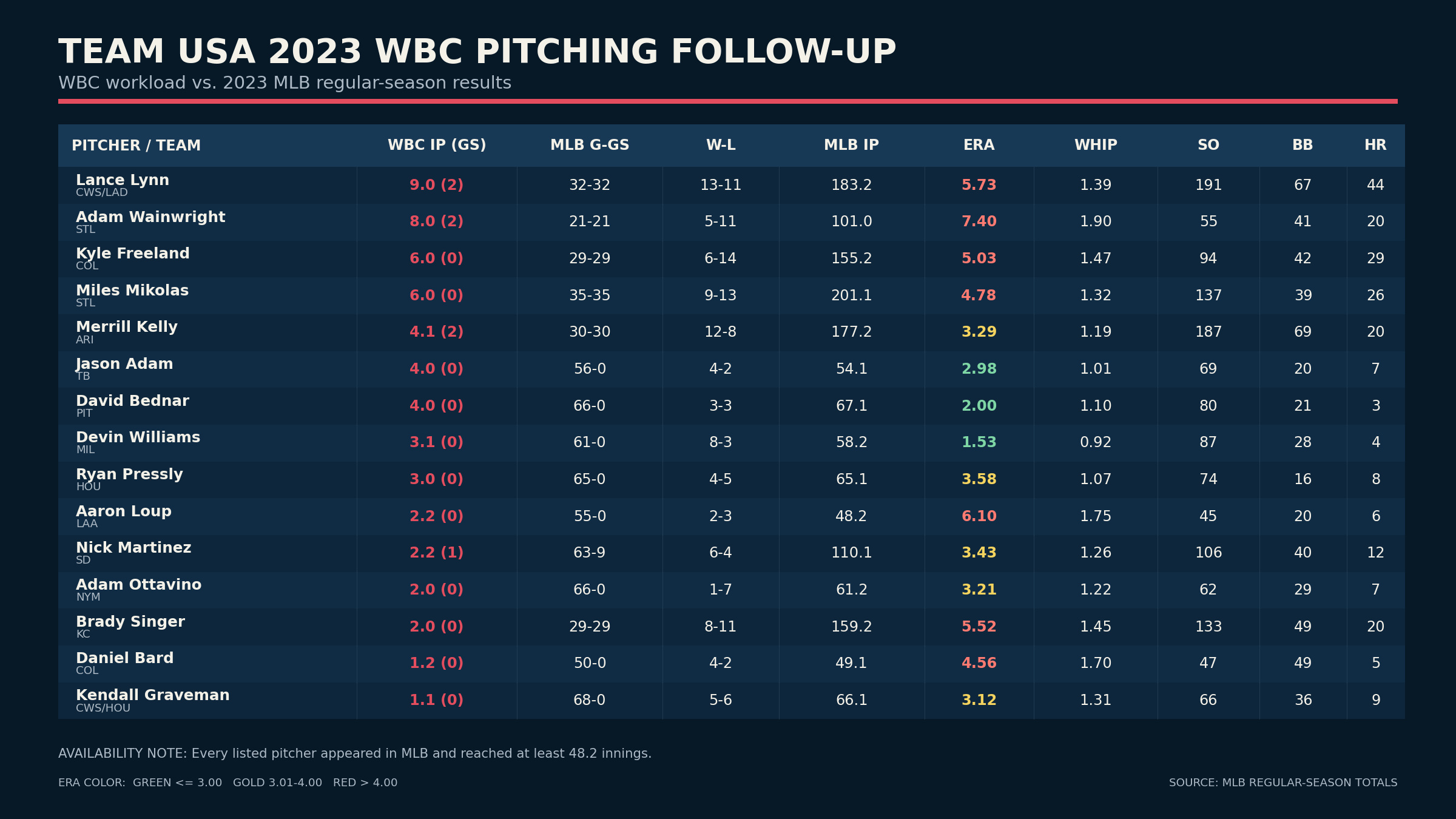
The heaviest-used starters had a rough follow-up. Lynn allowed 44 home runs with a 5.73 ERA, while Wainwright finished at 7.40 and dealt with groin and shoulder injuries in his final season. Lynn’s 2022 season was mediocre at best, so not a huge deal. Wainwright, by contrast, had a great 2022. How much of that was age, and how much was the WBC?
The problem extended beyond the two highest workloads. Freeland, Mikolas, and Singer all finished with ERAs above 4.75. Merrill Kelly was the starting-pitcher exception.
The relievers again performed better as a group. Bednar and Williams were elite, while Adam, Pressly, Ottavino, and Graveman remained effective.
Every pitcher appeared in the majors, and every member of the staff reached at least 48 2/3 innings. This was the healthiest group by basic availability, even though it produced the worst results.
2026 Team USA
2026 Takeaways
Webb and Skenes had the two largest WBC workloads, and both experienced noticeable declines. Webb still reached 160 2/3 innings despite two IL stints, while Skenes remained in the rotation all season but lost velocity and effectiveness.
McLean is the immediate counterexample. He threw only two fewer WBC outs than Skenes, then delivered 172 2/3 innings with a 3.18 ERA and 189 strikeouts.
The staff remained extremely productive. Wacha approached 200 innings, Skubal returned from elbow surgery to post a 2.85 ERA, and Miller, Whitlock, Rogers, and Bednar formed an excellent relief group. (Some will criticize the Skubal piece and say the elbow issue was caused by the WBC)
Which Staff Held Up Best?
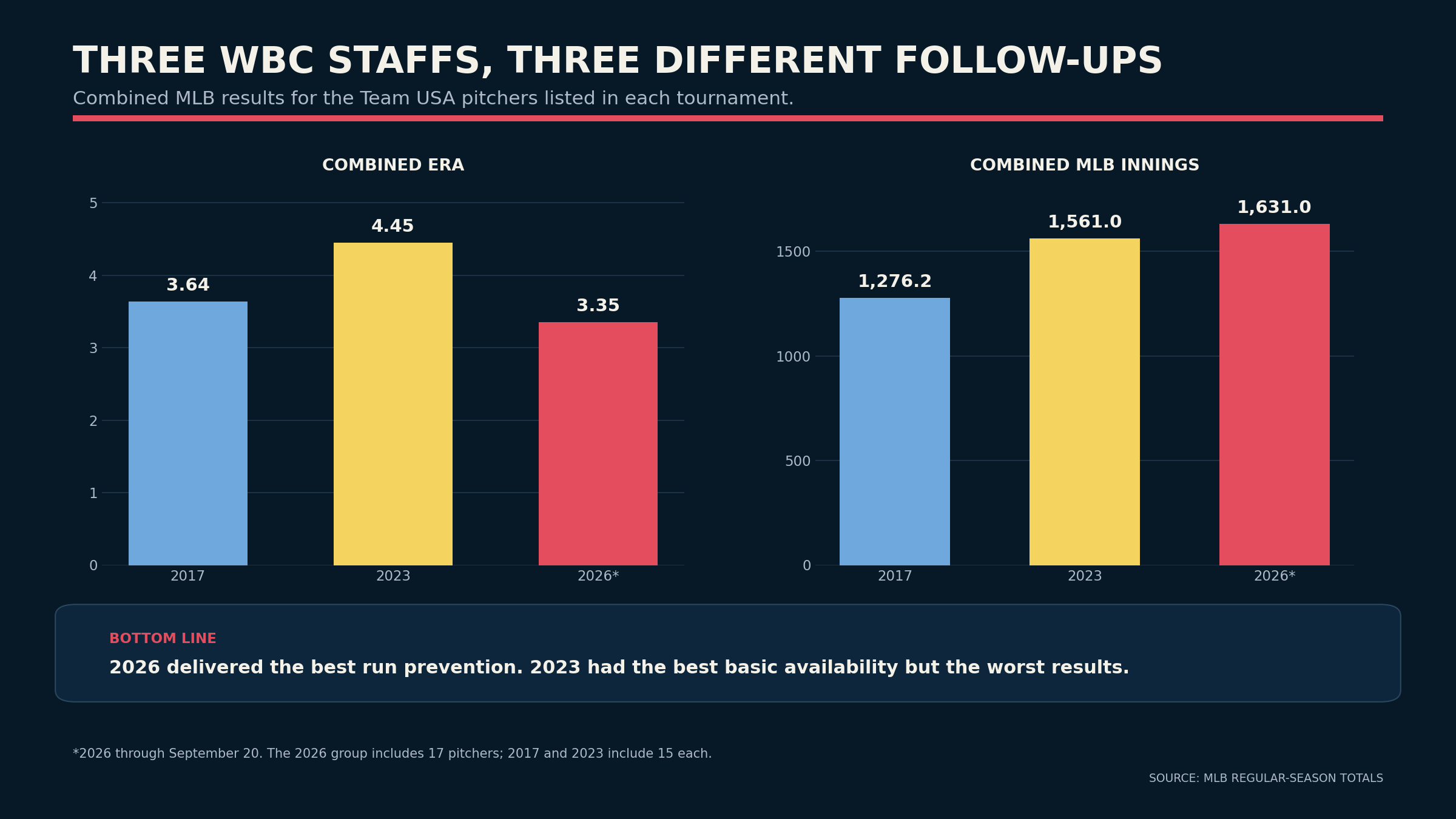
The rosters have different mixes of starters and relievers, and the 2026 group contains 17 pitchers compared with 15 in both earlier tournaments. So, take that into account when looking at total innings pitched.
The data suggests Paul Skenes might be an outlier here. The 2026 staff has produced the best follow-up season after the WBC. Its combined 3.35 ERA is the lowest of the three groups covered in this data set.
That does not make it the healthiest group. Keller and Vest suffered season-ending elbow injuries, Skubal required elbow surgery, and several other pitchers spent time on the IL.
The 2023 staff was the healthiest if health means availability. All 15 pitchers made it through the season with meaningful workloads. It was also easily the least effective group. Its 4.45 combined ERA came from ugly seasons by Lynn, Wainwright, Freeland, Mikolas, and Singer.
The 2017 staff landed smack in the middle. Stroman delivered the best single rebuttal to a simple WBC-fatigue theory, and the bullpen was outstanding.
So Was Skenes Right?
I am not going to pretend that I know Skenes’ body better than Skenes.
If he thinks that the WBC was the root of the issue for his down year, I am fine with that. Does the history of WBC pitchers back up his theory? No, not really.
No clear relationship exists between WBC innings and what happened afterward. The pitchers with the largest March workloads were not consistently the ones who got hurt. The pitchers who got hurt did not consistently throw the most innings in the tournament. Relievers generally handled the transition better than starters, but that pattern can also reflect the greater demands and larger seasonal workloads placed on starters.
Before the WBC, Skenes believed hard work and proper preparation could mitigate the risk. He no longer is believing that.