


At some point, youth sports, particularly baseball, stopped being a game and became an investment pitch.
“Your son needs better competition; he needs private training; he needs more exposure; he needs better equipment.” Blah, Blah, Blah.
Next thing you know, you are paying up the wazoo to send your son to showcases halfway across the country with the best equipment there is.
So many problems come from this. The biggest being the delusion that parents have when their child gets to high school. I cannot tell you how many parents think their child should automatically be on a varsity team. They all think that. Why? Because they have spent, in some cases, upwards of $100,000 on their child’s training.
I don’t blame all the parents. Yeah, some of them are just crazy. But many are being placed in a tough position. These youth sports have become like politics. You want in? Well, open up your wallet.
I believe that MLB could help fix this system.
It should steal one of the best ideas in European soccer and require every MLB organization to operate free, official youth teams.
Cry about it. Here’s my pitch.
The Person Evaluating Your Child Is Also Sending the Invoice
Look, there are excellent travel teams with great coaches. There are private instructors who care deeply about their players and provide valuable coaching. This is not a blanket accusation that all of them are bad.
It is an indictment of the system.
In youth baseball, the person evaluating a child is frequently the same person collecting money from the family. That is a HUGE conflict of interest.
What incentive does a private coach have to tell a family that weekly training is no longer necessary? What incentive does a travel team have to say a player would be equally served on a less expensive local team? How often does a coach tell a parent that their son is a perfectly fine player but might not be cut out for high school or college?
Honesty can cost that coach a customer and money.
The word “elite” has consequently lost almost all meaning. We have elite teams, elite camps, elite tournaments, elite instructors, and elite showcases. Some organizations operate multiple “elite” teams in the same age group.
In modern youth baseball, elite is often something a family purchases. In a legitimate professional academy system, like the one I am suggesting, it would be something a player earns.
(I am sure there is some corruption in the Premier League system, so there probably will be a little bit here as well.)
What Parents Are Really Spending
There is no reliable national average limited specifically to travel-baseball families. The Aspen Institute found that baseball families spent an average of $1,112.50 in 2024, but that figure includes recreational, community, and school baseball. Only 16.8 percent of the baseball families surveyed regularly participated in travel, elite, or club programs. It does not reflect the full cost of the private baseball pipeline.
Current prices tell a different story. One competitive travel program charges close to $4,000 after tuition, uniforms, and an additional tournament fee. On Long Island, private baseball lessons commonly cost $55 to $70 per half hour, adding another $1,650 to $2,100 for one lesson a week over 30 weeks. Then come bats, gloves, cleats, hotels, gas, meals, tournament admission, and destination events such as Cooperstown.
That makes $8,000 a reasonable annual benchmark for a family seriously invested in travel baseball, but a realistic picture of what the complete commitment can cost. If a child plays from age 10 through age 18, that is potentially $72,000 over nine seasons. Some families will spend less; many will spend more.
What percentage of those families should really be spending $72,000 on their child’s sports? Realistically, none, but if there is, it is a very small percentage.
In my pitch, that small percentage would be folded into the youth teams that the MLB teams would fund.
The Odds Never Match the Sales Pitch
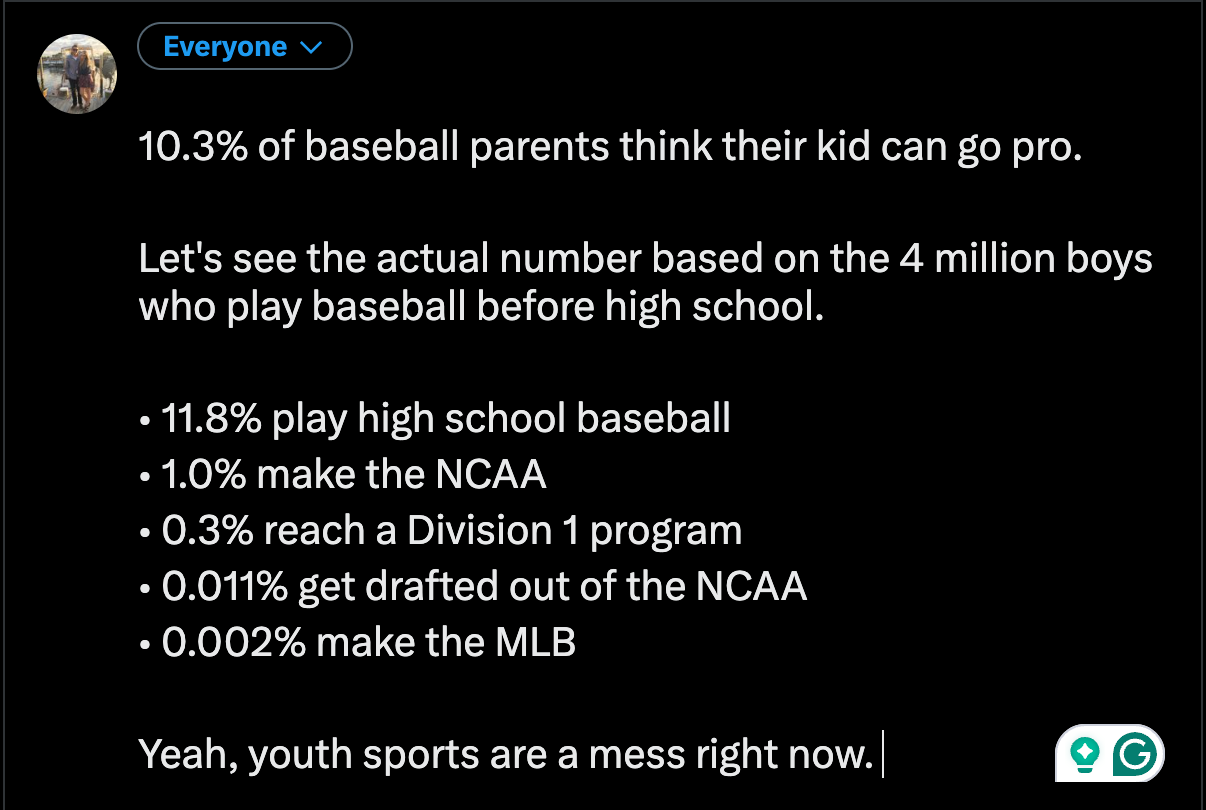
Data from the Aspen Institute's Project Play initiative (in partnership with Utah State University and Louisiana Tech University) surveyed nearly 2,000 youth sports parents and found that 10.3% of baseball parents believe their child has the ability to eventually reach professional sports.
That is an insane number. Want to guess how many play before high school? Around 4 million. How many of those play in high school? 472,598.
Those 10% of parents who think their son is going to go pro will be lucky if they play in high school.
Of that nearly half a million athletes playing in high school, around 41,580 competed at an NCAA school. So, about 8.8% reached the college level, with only 2.7% of them reaching Division 1.
The road narrows dramatically from there. The NCAA estimated that 9,240 college baseball players were eligible for the 2025 MLB Draft. Only 452 NCAA players were selected, or approximately 4.9% of the eligible group. That does not mean those 452 players will make it to MLB. It will probably be around 10%. (Seriously, I am shocked how many times it is 10%. It fits perfectly into what I am doing.)
These percentages really drive the point home.
The Premier League Offers a Different Model
Across the pond, the Premier League teams have a different process. Academies there can begin at the Under-9 level and continue through the Under-21 teams.
The league’s Elite Player Performance Plan classifies academies from Category One through Category Four based on factors including coaching, facilities, education, welfare and player development. A Category One academy provides a complete U9-to-U21 pathway and can offer full-time education beginning at U12.
Players receive professional coaching. The age-group teams play organized schedules against other academies. Clubs track their development and provide medical, educational, and performance support. The biggest part is that parents aren’t paying for this.
It is not a perfect system. Some players are recruited too early; there is a lot of pressure, and, like with baseball, most will not make a Premier League team.
But the pathway to the pros is there, and it is not a “pay-to-play” model like the one we see in baseball in the United States.
Seriously, do you think these “elite” teams in America would ever spend money on the educational, mental, and physical well-being of these boys? No.
Want to know who can afford to? Major League Baseball teams.
What Would MLB Youth Teams Look Like?
Imagine every MLB organization operating official U13, U15, and U18 teams.
Players would compete regionally during the season, with national tournaments or an academy championship held at major-league and spring-training facilities.
Because the United States is too large for 30 locations to cover the entire country, MLB organizations could use their minor-league affiliates and existing youth facilities as regional development centers. Open community programs could serve thousands of players.
The system would include:
Free regional tryouts
No team dues or participation fees
Equipment and uniforms supplied by the organization
Travel, lodging, and meals paid by the club
Licensed coaches who are not compensated based on roster size
Independent medical and child-welfare oversight
Strict pitch limits and mandatory offseason rest
Educational support and coordination with local schools
Published evaluation standards
Multiple opportunities to enter the system as players develop
Honest exit meetings for released players and their families
Public reporting on advancement, injuries, and player outcomes
Keep the Draft
MLB should adopt the Premier League's developmental structure without copying its approach to player ownership. (Although I love signing 15-year-olds in FIFA and having them come up early and become stars.)
A 13-year-old should not sign away his future rights to the organization operating his youth team. (Ironically, as I am writing this, I am pretty sure a 12-year-old just signed with a team.)
Academy players should remain eligible for the normal MLB Draft, and participation should not prevent them from attending the school or college of their choice.
That means the Mets might invest in developing a player whom the Cubs eventually draft. The goal is to expand and improve the sport, not to allow teams to acquire permanent control over children.
There is also a historical reason to retain the draft.
Before MLB introduced its amateur draft in 1965, high school and college players could sign with any team. The best amateurs could effectively offer their services to the highest bidder. The draft gave weaker organizations an opportunity to select the best young talent rather than allowing the wealthiest clubs to dominate amateur recruitment. The goal is to avoid the Dodgers giving 70-year deferred contracts to 12-year-olds.
The solution is central funding and strict limits. Every organization should receive the same baseline resources from an MLB development fund (I am sure they would argue about it). Territories should be balanced by youth population rather than simple mileage, with league-operated academies covering areas without nearby franchises. We aren’t looking to uproot families too much here.
MLB Has Already Proven Part of This Can Work
This would not require starting from nothing.
MLB already operates youth academies and development programs around the country. The Houston Astros MLB Youth Academy offers free, year-round instruction for players ages 7 through 17, along with tutoring, career development, and other educational programming. The Texas Rangers Youth Academy similarly provides free instruction for athletes between 7 and 18.
What MLB lacks is a connected national structure: official age-group teams beneath every MLB organization, standardized coaching and welfare requirements, regional competition and a visible pathway from community programming to the highest youth level.
What Happens to Travel Baseball?
Travel baseball would not disappear (Sadly).
MLB would not be able to fund teams for the 4 million kids who play baseball. Plus, some talented players might not want to participate in the MLB programs.
But those coaches and teams would have a much more difficult time selling a bag of lies that leads over 10% of parents to think their child can be a pro.
If MLB organizations held free open trials, employed regional scouts and operated their own youth leagues, “exposure” would become a much harder product to package and sell. A team could not imply that attending its expensive tournament was the only way to be discovered when every MLB organization already had its own free versions across the country.
Let The Kids Play… The Right Sport
Growing up, most kids played at least three sports. Now, we are seeing children practically out of the womb focusing on one sport their entire childhood.
I loved soccer and baseball growing up. But when it came time to go to high school, I was told those would not be an option. So, I just pivoted to my third sport, track, and went on to become an All-American runner and compete in college.
Did I want to run track? Hell no. I wanted to play soccer. But I couldn’t, and when that happened, I just transitioned easily over to another sport.
We aren’t seeing that today. Now we have parents who are convinced their son or daughter should automatically play in high school because they played the same sport for the last ten straight years and spent 100,000 doing so.
Major League Baseball doing youth academies like this will not eliminate all the problems that are starting to pop up in youth sports, but I think it will at least start the healing process.
Children should be allowed to play baseball, or any sport, without every season becoming a financial bet on a future scholarship or professional contract. Parents should not have to spend tens of thousands of dollars simply to prove they did everything possible.
If you haven’t already, please consider subscribing below.