


I was really hoping I didn’t have to do this today. I have a few great blog drafts that I want to focus on. Players outperforming their contracts, MLB needing a Czar as a commissioner, updates on Stat Soldier, etc.
But then I saw Jeff Passan's tweet about some new Ted Williams footage. I thought, “Perfect.” What a relaxing way to spend the day. Until I saw some of the comments. Immediately, the gremlins like Will Mossa from Overdue Sports jumped into the comment section about how Ted Williams wouldn’t survive a day in today's baseball. To me, it is one of the most frustrating arguments out there, and for the exception of Will, because I love him, if you die on a hill saying one player couldn’t play in the next, then you should go watch football or some other boring sport.
In 2026, with all the advancements in medicine, training, and nutrition, Ted Williams would absolutely tear the league apart. Honestly, I believe that about any peak player from any era. If you were the best of the best in your generation, and you were plucked up and given all the perks and benefits that modern-day players get, I think you would be great here as well. I do not think that goes both ways. Pick up a modern-day player and throw them into the 1910s, and they probably get sick within an hour and never play again.
But let’s just put all of that to the side for the moment. Williams's greatest asset was his eyesight and hand-eye coordination. That doesn’t disappear if he is playing in today's game. Let’s also break down where Williams would rank if he didn’t serve our country in TWO wars.
Many in baseball have spent more than eight decades reducing Williams to his .406 season. It is a magnificent story, the last .400 season in American or National League history, but it is just the tip of the iceberg of his story. By constantly bringing it up, many just remember one achievement without confronting his entire career.
Ted Williams hit .344/.482/.634 across his career. He reached base in almost half his plate appearances, more than any qualified hitter ever. He walked 2,021 times, while striking out only 709 times. Was one of the most dangerous hitters until he was 40, all while losing nearly five full seasons to military service.
I have written about Williams plenty of times. He is not the greatest defensive player ever. He is not the greatest baserunner ever. He was not the most complete player ever. He WAS the greatest HITTER ever, even if he sometimes didn’t feel the same.
Williams’ .344 career average ranks tied for 10th on the qualified career leaderboard. It is important to note that he is the highest-post-1940 player. His .482 on-base percentage ranks first. His .634 slugging percentage ranks second, as do his 1.116 OPS and 191 OPS+. FanGraphs credits him with a 187 wRC+, also second in its historical American and National League database.
The No. 1 name ahead of Williams in slugging, OPS, and OPS+ is Babe Ruth.
In 1941, he did not simply hit .406. He posted a .503 on-base percentage and a .735 slugging percentage. He hit 37 home runs, drew 147 walks, and struck out only 27 times. He reached base in more than half of his plate appearances while producing nearly five and a half walks for every strikeout.
Then he nearly kept doing it forever.
Williams recorded seven full seasons with an OPS+ of at least 200. In a partial 1953 season, he posted a 268 OPS+ in 37 games. At age 38 in 1957, he hit .388/ .526/ .732, launched 38 home runs, and drew 119 walks against 43 strikeouts. Baseball-Reference credited him with a 233 OPS+ and 9.7 bWAR. Again, at 38.
The Five Seasons We Will Never See
Williams finished the 1942 season by winning the Triple Crown. He hit .356, led the American League with 36 home runs and 137 RBIs, and posted an on-base percentage just under .500
Then his age-24, age-25, and age-26 seasons disappeared.
Williams joined the Naval Reserve on May 22, 1942, entered active duty after the season, and spent the next three years training as a naval aviator and serving as a flight instructor. He did not fly combat missions during World War II. He missed the complete 1943, 1944, and 1945 major-league seasons before returning to Boston in 1946.
You would assume there would be some sort of drop-off. You would be wrong.
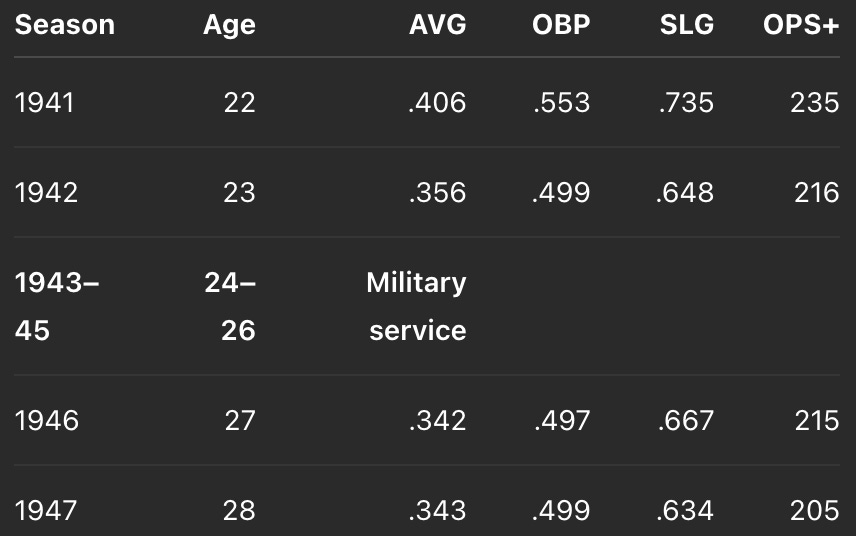
In his first season back in 1946, Williams hit .342 with 38 home runs, 123 RBIs, and a .497 on-base percentage. He won the American League MVP and helped Boston reach the World Series. Then, in 1947, he won the Triple Crown again. Remember, he didn’t win the MVP in EITHER season that he had the Triple Crown. Criminal.
Then the government called him again.
Williams remained in the inactive reserve after World War II and was recalled in January 1952. He entered active duty that May as a Marine Corps captain, trained on the F9F Panther jet, and was sent to Korea. He served in the same squadron as future astronaut John Glenn. A great book by Adam Lazarus about this time can be purchased here.
Williams missed 727 games due to World War II and the Korean War. With an average of 4 bats per game, he lost about 2,908 at-bats. That would have made his career total 10,614. Taking his average of .344, AB/HR of 14.79, and OBP of .482. I ran some numbers to see where he would fall in some major categories.
Editor’s Note: If you want to argue that we don’t know how he would have played in those missed years, I invite you to look at his stats before and after his deployment.
Ted Williams’ Estimated Career Totals Without Military Service
Based on his lost time due to WWII and the Korean War, Ted Williams’ projected career stats would be:
Hits: 3,654 (Would rank 3rd all-time behind Pete Rose and Ty Cobb)
Home Runs: 718 (Would rank 3rd all-time, behind Barry Bonds and Hank Aaron)
RBIs: 2,422 (Would rank 1st all-time, ahead of Hank Aaron’s 2,297)
Total Bases: 6,724 (Would rank 2nd all-time, behind Hank Aaron’s 6,856)
Where This Puts Him Historically
Only Hank Aaron (6,856 TB) would have more total bases than Williams’ 6,724.
He would be the all-time RBI leader, surpassing Hank Aaron.
His home run total (718) would place him just behind Bonds and Aaron, ahead of Babe Ruth (714).
With 3,654 hits, he would be in the rare club of elite contact hitters, sitting just behind Pete Rose and Ty Cobb.
Ted Williams finished his career with only two MVP awards. In my opinion, there are three other snubs, but the most glaring are his two Triple Crown Years. In 1942 and 1947, Williams won the Triple Crown. In neither year was he awarded MVP. I break that down in the blog below.
Worst MVP Snubs In MLB History

EDITORS NOTE: I just finished writing this novel, and all I have to say is… this is a BLOG. If you want charts on pitcher arm movement, check out Sam’s blog. If you want to know what the inside of a college baseball team’s bathroom looks like, go to the Overdue Sports blog. If you want to read a Top 10 that steals every cliche term a Sports Center ancho…
Look, this blog was put together in 10 minutes because I saw the Passan post. Just thought it was important to remind the critiques of an American Hero.
There's no doubt about it. If Babe Ruth was born in 2001 he'd be destroying the league. Same with Williamsy. Athletes are products of the styles and science of their times. What matters is how they competed against the other great athletes of their time. Jesse Owens would be just as good because he'd have the benefit of everything the modern athlete has.
People were dismissing Ted Williams? The guy was a phenomenal hitter. He hit a home run off an eephus pitch. He hit .388 when he was 38. He hit a HR in his final at-bat. And you’ve mentioned the war years already.
People are dumb.