


For most of baseball history, you were stuck with the team that signed you as a teenager. Good luck getting a contract, or much money at all. Before free agency, the owners pinched pennies harder than they do today.
Ever wonder why so many of baseball’s greatest players were signing autographs and doing appearances up until they were on their deathbed? It’s because they made no money.
Ted Williams: $1.5 million career earnings
Hank Aaron: $2.1 million career earnings
Willie Mays: $1.15 million career earnings
Joe DiMaggio: $700,000 career earnings
Babe Ruth: $856,000 career earnings
Even adjusted for inflation and taking into account all their other earnings, the combined net worths of just those five players at the time of their deaths were around $100 million. Over half of that comes from DiMaggio being the face of Mr. Coffee.
Then, in 1973, arbitration was introduced, with free agency following soon after, and over the last 50 years, players have been making more and more money.
Now? We have entered a new chapter.
Since 2018, MLB clubs have increasingly leaned into one of the most aggressive roster-building strategies in the sport: signing young players to long-term extensions before arbitration, buying out all of their arb years, and often pushing free agency into their late 20s or early 30s.
This is the world of Ronald Acuña Jr., Ozzie Albies, Julio Rodríguez, Corbin Carroll, Bobby Witt Jr., Jackson Merrill, Roman Anthony, Jackson Chourio, Kristian Campbell, Ceddanne Rafaela, and a growing list of players who signed away the traditional arbitration path before they ever had to go year-to-year with their teams.
And honestly? It’s a pretty mixed bag for the teams shelling out the money.
What These Deals Actually Are
Before getting into the names, let’s explain what is going on.
Under normal MLB rules, a player is generally under team control for six seasons. The first three are usually pre-arbitration years, during which the player earns close to league minimum. The next three are arbitration years, where his salary can climb quickly based on performance.
After that, he reaches free agency.
These extensions change that path.
Instead of waiting for arbitration, the team says:
“We’ll give you life-changing guaranteed money right now. In exchange, we get cost certainty, your arbitration years, and at least one or two free-agent seasons.”
The player gets security.
The team gets upside.
And if the player turns into a superstar, the team may have just saved itself tens — or even hundreds — of millions of dollars.
But if the player doesn’t pan out…. Well, these are billionaires, so who really cares?
The Acuña-Albies Blueprint
The modern version of this trend really started with the Braves.
In April 2019, the Braves signed Ronald Acuña Jr. to an eight-year, $100 million extension. At the time, Acuña was only 21 years old and had less than a full year of MLB service time. Albeit a Rookie of the Year's worth of service time.
The deal bought out his pre-arb years, all of his arbitration years, and multiple free-agent seasons. It also included club options for 2027 and 2028, meaning Atlanta could potentially control Acuña through his age-30 season. Which they will.
At the time, $100 million for a 21-year-old looked massive.
In hindsight, it became one of the most team-friendly contracts in baseball history. Acuna has already produced almost $200 million worth of value, and that doesn’t take into account the World Series and his MVP.
Just days after signing Ronald, they signed Ozzie Albies to a seven-year, $35 million extension. That one became even more controversial. Albies was already an All-Star-caliber second baseman, and Atlanta locked him up for an incredibly low guarantee with two club options attached.
Those two contracts became the template.
Not because every future deal would be that cheap — the market eventually corrected — but because teams saw the larger idea:
If you believe in a player early enough, you can buy their prime years before the market fully prices them in. And players have no problem locking up tens of millions of dollars.
The First Wave: Teams Testing the Market
From 2018 through 2020, teams started experimenting with this model more aggressively.
Some deals were attached to players who had barely played in the majors. Others were signed before the player even debuted.
The early group included:
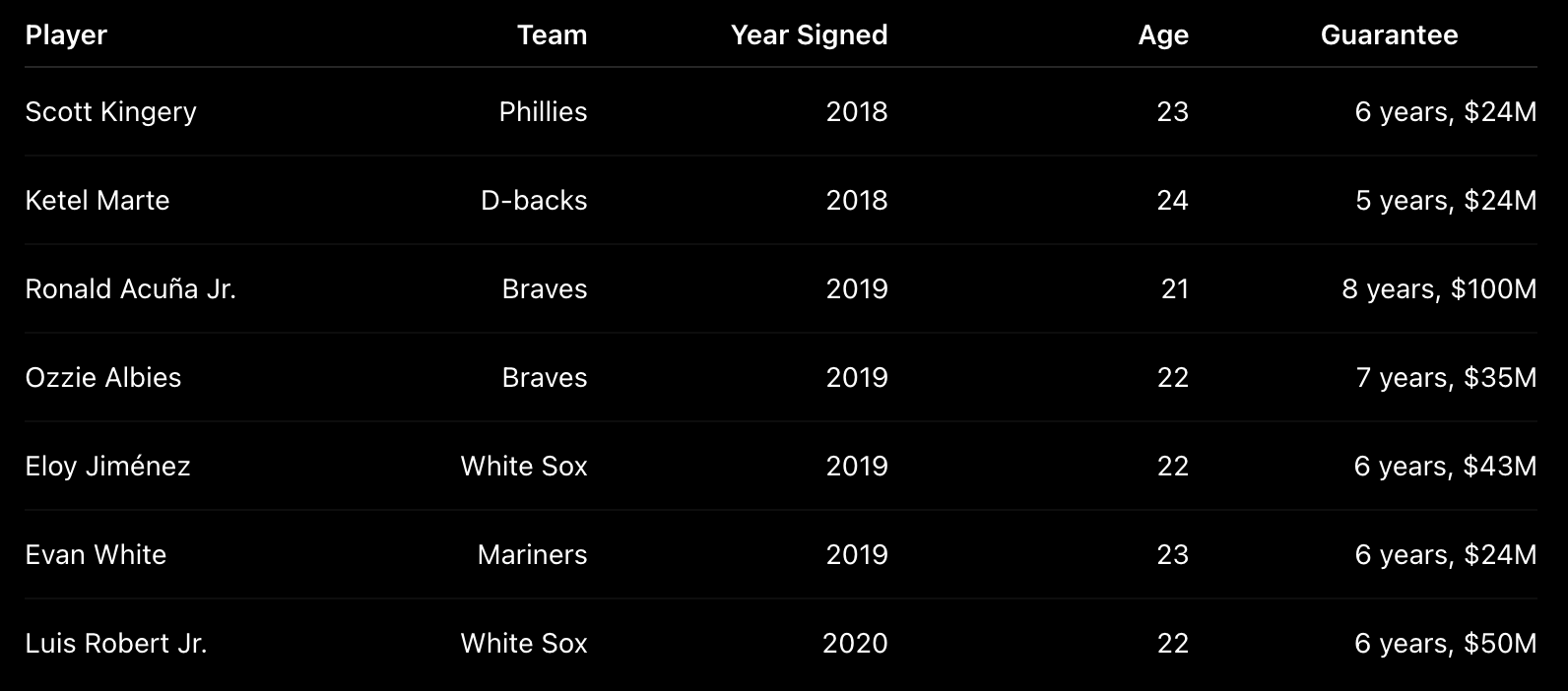
This group is fascinating because it shows both sides of the risk.
Acuña and Albies became enormous wins for Atlanta.
Luis Robert Jr., when healthy, looked like exactly the kind of player this model is designed for.
But Scott Kingery and Evan White also showed the danger. These deals are not automatic wins. If the player does not develop, gets hurt, or simply never becomes the player the team thought it was buying, the club is stuck with a guaranteed contract for a player who might not produce enough value.
That is the tradeoff.
Then the Numbers Got Bigger
Once teams got comfortable with the concept, and the Braves won a World Series, the money started climbing.
That is how we got deals like:
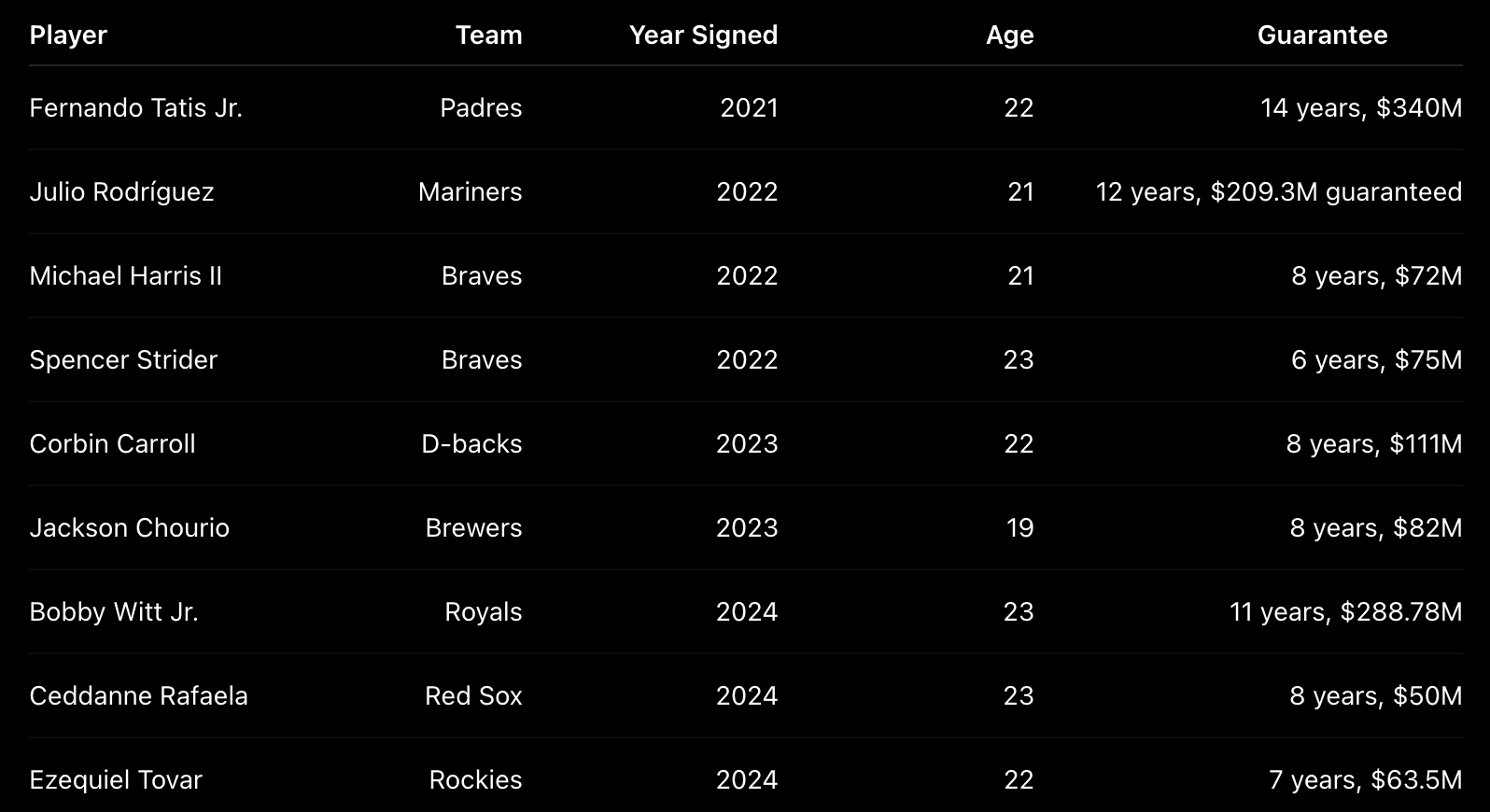
This is where the trend changed.
The early deals were mostly team-friendly gambles. But by the time we get to Tatis, Julio, Carroll, Witt, and Chourio, these are no longer small bets. These are franchise-shaping decisions.
The Padres looked at Tatis and said, “This is our guy for the next decade-plus.” Then he got ringworm and drove a motorcycle
The Mariners looked at Julio and built one of the most complicated young-star contracts ever. (It could end up being like 17 years and over $400 million. It won’t, but it could, and it’s confusing.)
That Witt deal is especially interesting because it is one of the more player-friendly contracts in this category. It includes player opt-outs and gives Witt far more flexibility than a traditional team-control extension.
Players and agents saw what happened with Acuña and Albies. They were not going to keep giving teams the same level of discount forever.
The Prospect Extension Era Is Here
In the last two years, these contracts have exploded. You still have your Merrills and PCA’s who sign after showing some promise, but now guys just sign before getting a single at-bat.
Recent examples include:
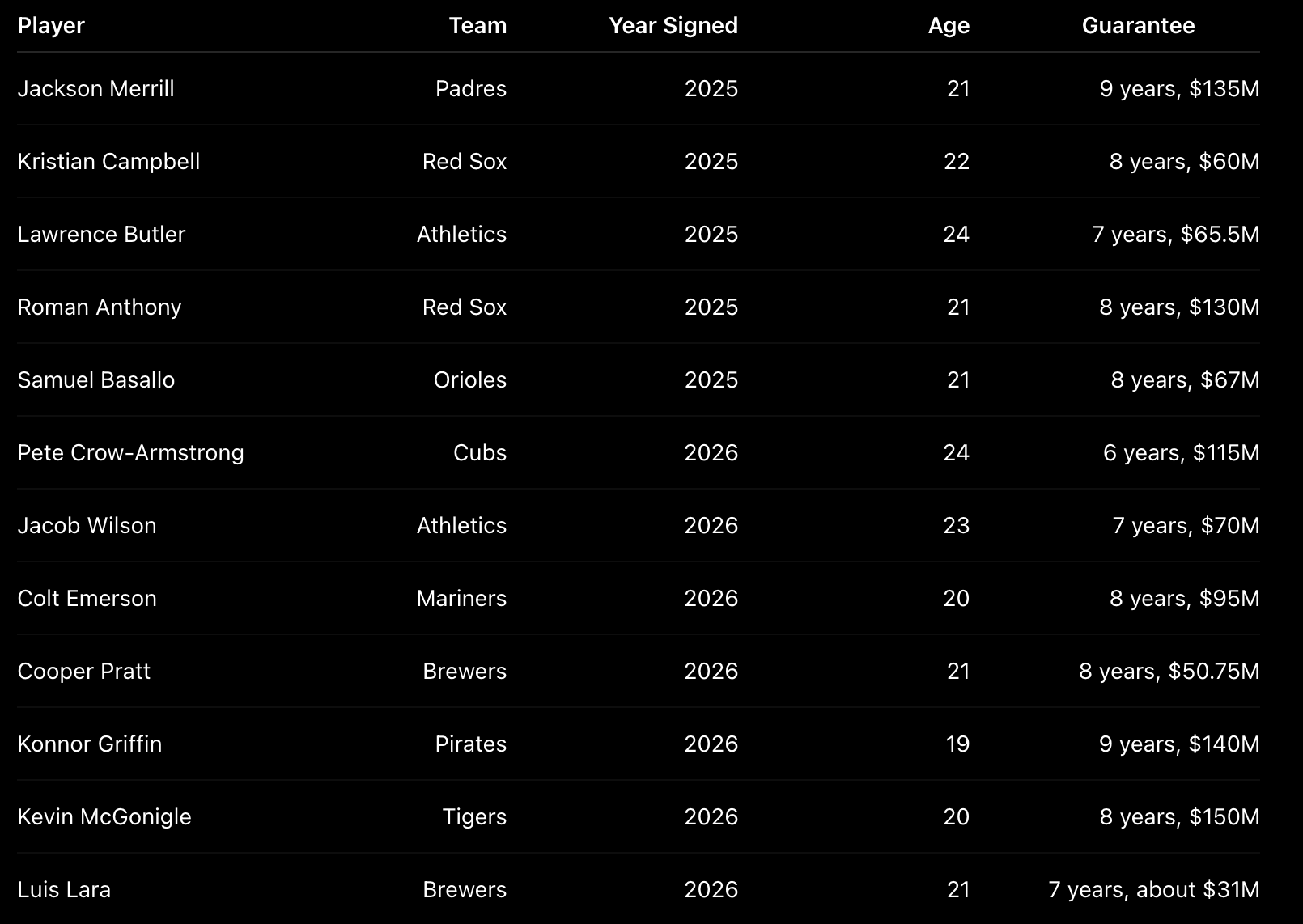
The cheapest contract here, Luis Lara, is more than Albies signed for. Keep in mind, Albies was already an All-Star. Lara is still in the minors.
It is WAY too early to make any determination on these contracts.
What Are The Results Of All These Deals
Frankly, it is a mixed bag right now for the teams that have committed to their young players early. I will break it down into three categories. Worked, So Far So Good, Bombed, Jury Still Out.
I added a few players (Bello, Greene, Keith, Hayes, Franco), that I did not reference in the work above.
Worked:
Ronald Acuña Jr.
Ketel Marte (Sort of)
His initial contract did.
Ozzie Albies (He got robbed)
So Far So Good:
Julio Rodriguez
Corbin Carroll
Jackson Chourio
Bobby Witt Jr
Pete Crow-Armstrong
Kevin McGonigle
Bombed:
Scott Kingery
Eloy Jimenez
Evan White
Luis Robert Jr
Ceddanne Rafaela
Kristian Campbell
Brayan Bello
Ke’Bryan Hayes
Wander Franco (Duh)
Jury Still Out:
Fernando Tatis Jr (Go look at it and come back)
Roman Anthony
Ezequel Tovar
Michael Harris II (Leaning towards worked)
Spencer Strider (Was great, now isn’t)
Samuel Basallo
Jacob Wilson
Colt Emerson
Konnor Griffin
Luis Lara
Cooper Pratt
Lawrence Butler
Jackson Merrill
Hunter Greene
Colt Keith