


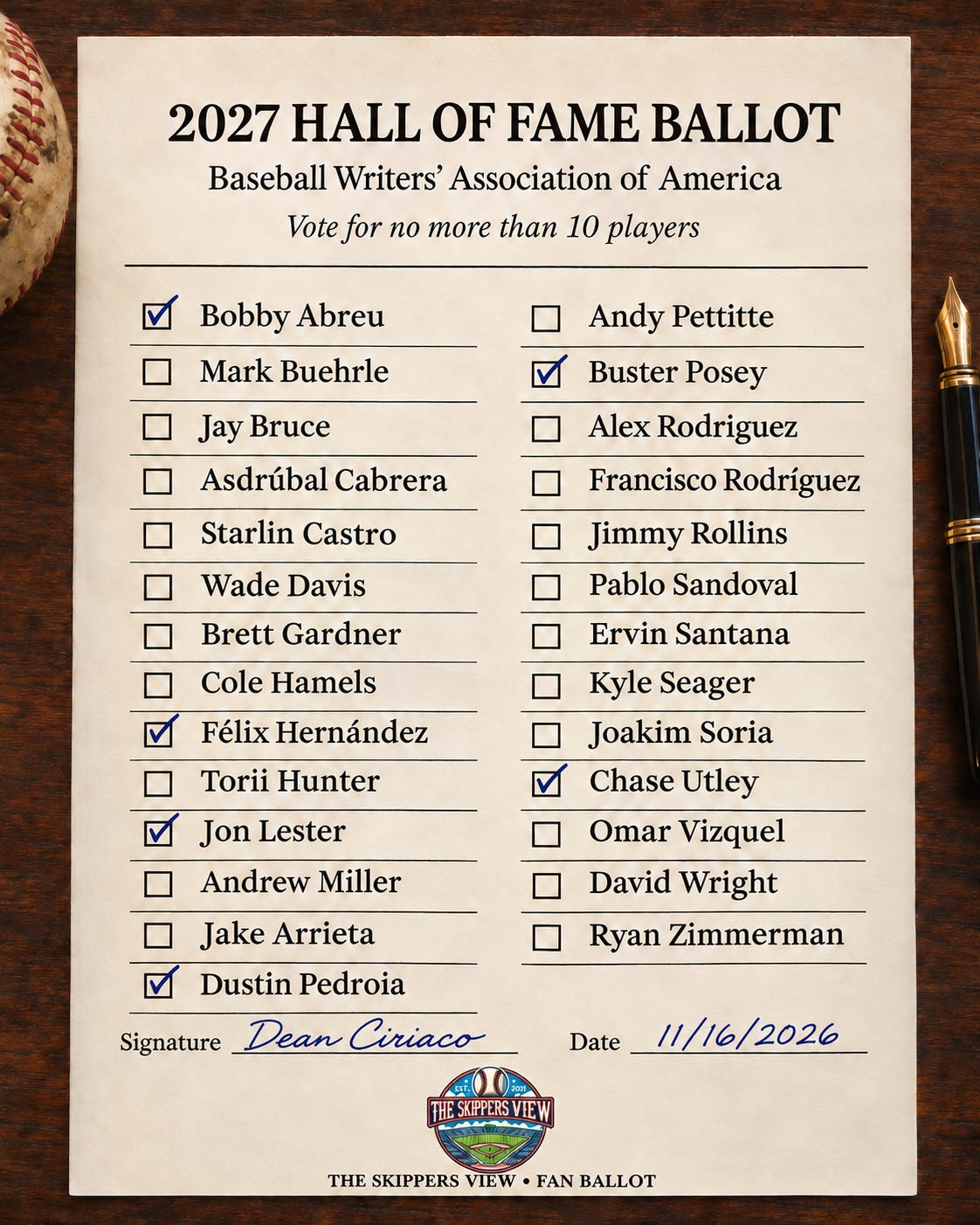
Hello there, and welcome to my 2027 Hall of Fame ballot. This is the fourth year I’ve shared my Cooperstown picks, and this year I've selected the most players.
First, a reminder that I don't have an official BBWAA vote. This is my own TSV ballot, which I fill out every year. Ballots for official voters aren't due until December 31st, and the results will be announced January 19th.
Last year, I voted for Andruw Jones, Carlos Beltrán, and Dustin Pedroia. Jones and Beltrán got in, and I got to report them in person at Cooperstown. Pedroia is back on my ballot, joined by five other names.
Before we get to them, I need to address two things.
I don’t vote for players with documented performance-enhancing drug use. Sorry. They cheated, and the argument that “everyone was doing it” has never worked for me. I agreed with Joe Morgan’s 2017 letter to voters, which made clear how strongly many Hall of Famers opposed electing steroid users.
I took Chase Utley off my 2025 and 2026 ballots because I wanted Pedroia on there and was being a biased Red Sox fan. I was very open about that, and looking back, that wasn’t a good reason to leave Utley out. So, he made it this time around.
All right, here’s the ballot.
Editor’s Note: I make a note of it at different points, but I do not believe that any of these players are “First Ballot Hall of Famers.” I guess I am contradicting myself by then voting for Posey and Lester. But to each his own.
Buster Posey
So, I don’t think that Buster Posey should be a shoo-in first-ballot HOFer. I see a lot of people saying that, but the numbers just don’t justify it. I am old school and do believe that players should have to wait a few years, even in a weak year (I think this is very much a weak year). The saying “First Ballot Hall of Famer” still means something to me.
That being said, Posey was a winner.
Positives
A career .302/.372/.460 line, 1,500 hits, 158 home runs, and 729 RBI in 1,371 games, all with the Giants.
The 2010 NL Rookie of the Year and 2012 NL MVP. He led the majors with a .336 batting average in his MVP season.
Seven All-Star selections, five Silver Sluggers, and a Gold Glove in 2016.
Three World Series championships: 2010, 2012, and 2014.
One of only six catchers with a .300 career average and at least 1,000 games played.
A 36.5 WAR (WAR7), which clears the 34.9 average for Hall of Fame catchers. His 40.8 JAWS sits just shy of the 44.3 positional standard, despite his shorter career.
Negatives
A short career by Hall of Fame standards
1,500 hits. If he wasn’t a catcher, we wouldn’t even be having this conversation.
Only one 100-RBI season, in 2012.
Jon Lester
Like Posey, this is Lester’s first year on the ballot. If Lester was on the ballot last year, I probably don’t put him on. Actually, I definitely wouldn’t. But I need to change my mindset on pitchers, and that starts this year.
Lester’s numbers are in no way in line with what a typical “Hall of Fame Pitcher” would look like. But we live in a new world, and the standards now need to change.
To be transparent, his WAR, WAR7, and JAWS are well below the average for a HOF starter. So, where I used that as a defense for Posey to compensate for his counting numbers, I have to do the opposite here. Lester has numbers I don't think any modern-age pitcher will hit, particularly 200 wins, nearly 2,500 strikeouts, and more than 2,700 innings.
Positives
A 200-117 record, 3.66 ERA, 2,488 strikeouts, and 2,740 innings across 16 seasons. Career WAR: 43.5.
Five All-Star selections and four top-10 Cy Young finishes, including a second-place finish in the NL in 2016.
Three World Series titles: 2007 and 2013 with Boston, and 2016 with the Cubs.
A 9-7 postseason record with a 2.51 ERA and 133 strikeouts in 154 innings. He also shared the 2016 NLCS MVP award.
A no-hitter against the Royals on May 19, 2008.
Negatives
He never won a Cy Young Award.
His 3.66 ERA and 43.4 WAR are far from what a “Hall of Fame Pitcher” should look like.
October carries a lot of weight for me here. Lester helped Boston win twice, then helped Chicago end its championship drought.
Chase Utley
Fourth year on the ballot. His 59.1 percent last year led all returning candidates, putting him closest to the 75 percent needed for election.
I voted for him in 2024, took him off for two years, and am putting him back. (In large part because I am keeping Pedroia on.)
Positives
A career WAR of 64.6, the highest of my six picks. He hit .275/.358/.465 with 1,885 hits, 259 home runs, and 1,025 RBI.
An outstanding peak. His WAR totals from 2005 through 2009 were 7.3, 7.3, 7.8, 9.0, and 8.2, averaging 7.9 per season. That drives a 49.3 WAR7 (well above the 44.2 HOF second baseman average) and a 56.9 JAWS (clearing the 56.6 standard).
Six All-Star selections and four Silver Sluggers at second base.
A World Series championship with the Phillies in 2008.
Five home runs in the 2009 World Series, tying the record for a single Series.
Negatives
No MVP, although he finished in the top 10 three times.
He didn’t become a regular until age 26, and injuries shortened the back end of his career.
A .224 postseason batting average.
Utley’s peak was too good for me to keep leaving him off. If I am going to continue to vote for Pedroia, I need to start keeping Utley on here as well.
Dustin Pedroia
Third year on the official ballot, after receiving 20.7 percent last year. This is also the third time I’m voting for him.
I’ll acknowledge that this is a homer pick. But it’s my list, so back off.
Positives
The 2007 AL Rookie of the Year, followed by the 2008 AL MVP.
Just the fourth player to win Rookie of the Year and MVP in consecutive seasons.
Four Gold Gloves, four All-Star selections, and a Silver Slugger.
A central role in Boston’s 2007 and 2013 championships. He also earned a third ring in 2018, although he was injured.
A .299 career average, 1,805 hits, 140 home runs, and 51.8 WAR across 14 seasons, all with the Red Sox. (If you haven’t noticed, I love when a player stays with the same team.)
Even with the injuries, his 46.4 JAWS ranks 20th all-time at second base. This puts him ahead of Hall of Famers like Jeff Kent (45.6), Bobby Doerr (44.1), and Nellie Fox (43.2).
Negatives
Knee injuries cut his career short, leaving his 51.8 WAR, 40.9 WAR7, and 46.4 JAWS all below the Hall of Fame second baseman averages (69.1 WAR, 44.2 WAR7, 56.6 JAWS).
The 1,805 hits.
At 20.7 percent after two years, he still has a long way to go with the actual voters.
Will he get in? Probably not.
Félix Hernández
Third year on the ballot, after receiving 46.1 percent last year. I left him off a year ago. This time, he’s in.
Positives
A career 169-136 record, 3.42 ERA, 2,524 strikeouts, and 2,729⅔ innings over 15 seasons, all with Seattle. Career WAR: 49.9.
The 2010 AL Cy Young Award: a 2.27 ERA, 232 strikeouts, 249⅔ innings, and 7.2 WAR despite a 13-12 record.
Two AL ERA titles, in 2010 and 2014. In 2014, he went 15-6 with a 2.14 ERA, 0.915 WHIP, and 6.4 WAR.
Cy Young runner-up finishes in 2009 and 2014. His 2009 season included a 19-5 record and 2.49 ERA.
Six All-Star selections.
A perfect game against Tampa Bay on Aug. 15, 2012, the 23rd in major league history.
Negatives
The decline came early. His ERAs from 2016 through 2019 were 3.82, 4.36, 5.55, and 6.40, with negative WAR in the final two seasons.
His 49.8 career WAR, 38.5 WAR7, and 44.1 JAWS all sit well below the Hall of Fame starting pitcher averages (73.0 WAR, 49.8 WAR7, 61.4 JAWS).
He never pitched in a World Series, so there’s no October case like Lester’s to add to the argument.
His 169 wins fall well short of traditional Hall of Fame benchmarks, and even below my new number of 200.
Last year, I used a pitcher like Tarik Skubal as an example of how peak dominance could eventually matter more than the old counting numbers. Hernández deserves that same consideration. His 2009, 2010, and 2014 seasons were elite, with other strong years around them.
His steep decline at age 30 is his biggest hurdle right now.
Bobby Abreu
Eighth year on the ballot, after receiving 30.8 percent last year. Personally, I have been keeping him off my ballot, but he is arguably the most all-around player on this list.
Positives
A career WAR of 60.2, more than Posey, Lester, Hernández, or Pedroia. His 41.6 WAR7 is essentially dead even with the 42.3 Hall of Fame right fielder average, and his 50.9 JAWS ranks 22nd all-time at the position. This number puts him ahead of Hall of Famers like Vladimir Guerrero (50.3) and right on the heels of Dave Winfield (51.1) and Ichiro Suzuki (51.8).
A .291/.395/.475 career line, with 2,470 hits, 288 home runs, 1,363 RBI, 1,476 walks, and 400 stolen bases over 18 seasons.
Eight consecutive seasons with at least 100 walks, from 1999 through 2006. He led the majors with 124 walks in 2006.
Nine seasons with at least 20 home runs and 20 stolen bases: 1999-2005, 2008, and 2010.
One of only two players, alongside Barry Bonds, with at least 1,400 runs, 1,400 walks, 1,300 RBI, and 400 stolen bases.
Two All-Star selections, a Silver Slugger, and a Gold Glove.
A total of 574 doubles.
Negatives
The awards are thin for a Hall of Fame outfielder: two All-Star selections and no MVP.
He never won a World Series.
His support has remained around 30 percent on the official ballot.
He is the only player on my list that I can put his name next to Barry Bonds.
Why I Left Some Names Off
Voters can put 10 names down. I used only six. Look, my mind could definitely change next year. Players like Hamels, Wright, Rollins, and Buehrle have numbers similar to some players on my list.
However, I was never “WOWED” when watching any of those guys. Aside from David Wright's bare-handed catch and Buehrle’s perfect game (which I don’t remember watching, but I know happened), nothing really pops out to me.