


Brandon Woodruff has already earned every sentimental reason the Brewers could need to put him on their World Series roster. He has not yet earned the roster spot.
That distinction matters because Milwaukee is four wins from its first championship. A World Series roster is not a lifetime-achievement ballot, even when the candidate is the longest-tenured player in the organization and has spent three years fighting the same right shoulder.
As of Monday morning, my answer would be no. Woodruff still needs to face hitters.
If he does that twice, holds his velocity, throws the changeup for strikes and recovers well enough to repeat the work, my answer changes to yes. The Brewers can afford a controlled gamble with their final pitching spot. They cannot afford a ceremonial one.
Why This Is Even a Conversation
Three months ago, Woodruff’s season appeared finished.
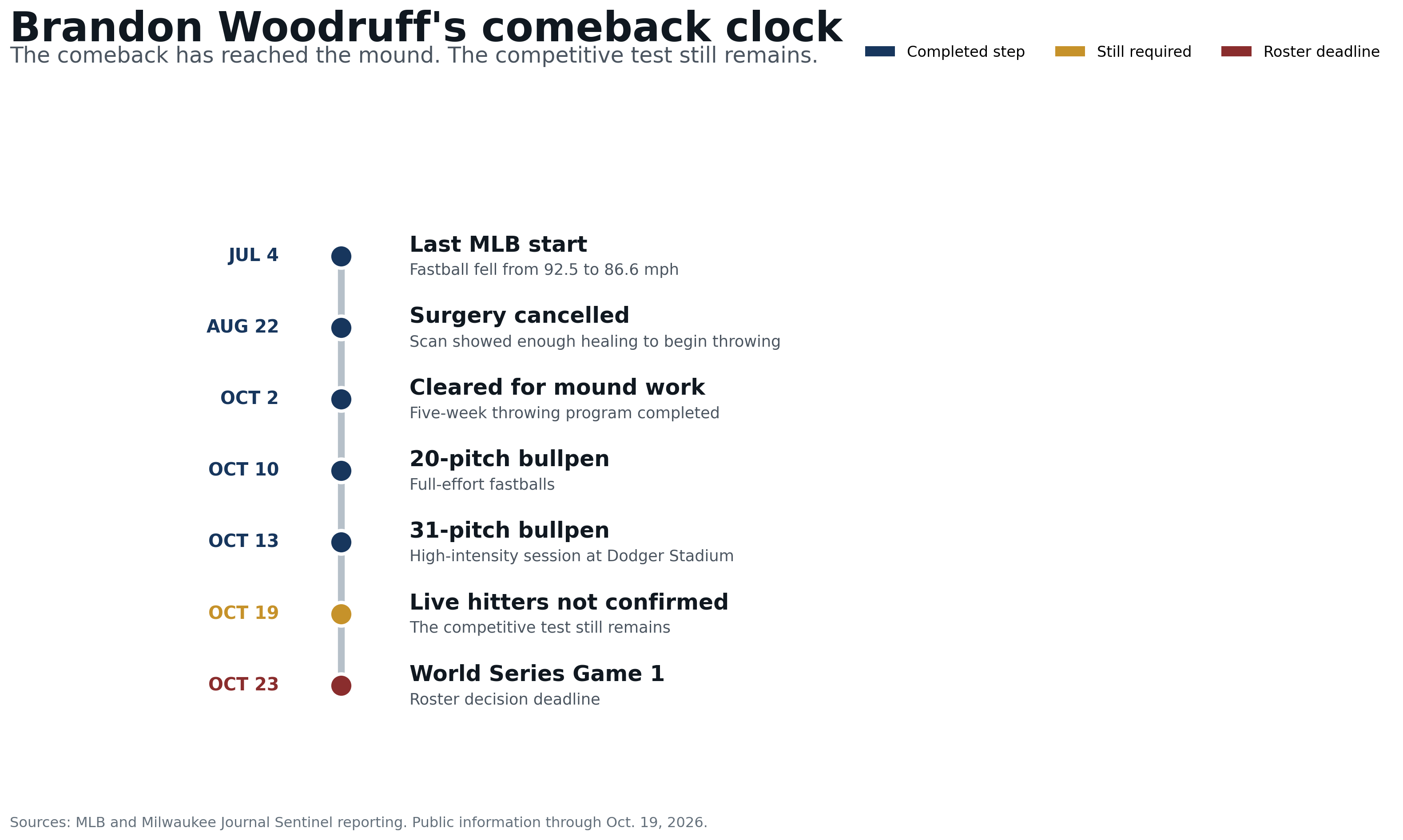
He left his July 4 start in Arizona after 3 2/3 innings. His fastball dropped from 92.5 mph in the first inning to 86.6 in the fourth. His changeup fell from 82.9 to 76.6. Milwaukee placed him on the injured list the next day, and doctors later diagnosed another injury to the capsule in his right shoulder.
The initial plan called for a second capsule repair. Woodruff had undergone the first operation in October 2023, missed all of 2024 and did not return until the middle of 2025. Another surgery placed more than the rest of this season in doubt.
Then his August scan showed enough healing to cancel the operation. He began a five-week throwing program. His surgeon later cleared him to work from a mound. Woodruff threw 20 fastballs at full effort on October 10 and followed with a 31-pitch, high-intensity bullpen at Dodger Stadium three days later.
The public checklist has always included one more item: live hitters.
That is the difference between a promising bullpen and evidence Milwaukee can use. A side session can show velocity, movement and whether Woodruff feels pain. It cannot reproduce a hitter refusing to chase the changeup, spoiling the fastball or forcing him to throw from the stretch with adrenaline in the way.
The Brewers have until Friday’s World Series opener. The deadline is close enough that good intentions no longer count as progress.
The Roster Cost Is Smaller Than It Looks
Milwaukee carried 13 pitchers in the Division Series and again in the National League Championship Series. Three did not pitch in the first round. Kyle Harrison and Chad Patrick remained unused through the four-game sweep of Los Angeles.
That does not make either pitcher disposable. A seven-game series can produce a 13-inning night, a short start or a rain delay that ruins the next day’s plan. Matt Arnold cited Milwaukee’s exhausted staff in the 2018 NLCS when he explained why the club retained so much length for the Dodgers series.
But the final roster decision is not Woodruff against Milwaukee’s best reliever. It is Woodruff against the last pitcher who would otherwise make the roster.
The Brewers can change their 26-man roster before each postseason round. Woodruff is eligible because he was on the 60-day injured list entering September. If he suffers another injury during the World Series, Milwaukee can ask the Commissioner’s Office to replace him with another pitcher. There is no subsequent round for him to miss.
That protection makes the medical risk easier to manage. It does nothing about ineffectiveness. A pitcher cannot be replaced because his command is poor or his fastball is getting hit. If Woodruff is healthy enough to remain active but unable to get outs, Milwaukee owns that decision for the rest of the series.
That is why live batting practice is more than a final box for the medical staff. It is the closest available test of whether Woodruff is better than the alternative.
The Pitcher Milwaukee Remembers Is Worth the Attempt
Woodruff was still effective when he could take the ball this season. In nine starts, he had a 2.98 ERA, a 0.84 WHIP and 47 strikeouts in 45 1/3 innings. His career postseason record covers only 28 1/3 innings, but the results are strong: a 3.18 ERA, a 0.85 WHIP and 40 strikeouts.
Those numbers explain the temptation. They do not answer the current question.
The pitcher from April or June had been built to start. The pitcher trying to return in October has not appeared in a game since July 4 and is preparing for relief work on an emergency timeline. Milwaukee is not deciding whether healthy Brandon Woodruff is better than its 13th pitcher. Of course he is. Milwaukee is deciding whether the version available Friday can throw 15 useful pitches against a World Series lineup.
His 2026 pitch mix offers a plausible relief role. His changeup was the better-performing pitch, holding hitters to a .133 average and a .167 slugging percentage in the Statcast record. His sinker was hit much harder. If the changeup is sharp enough to miss bats and the fastball is firm enough to protect it, Woodruff does not need to look like his 2019 All-Star self.
He does need two pitches he can command.
This is where the radar gun matters even if Woodruff would prefer not to look at it. Velocity is not the entire evaluation, and his career no longer depends on throwing 98. It mattered on July 4 because the decline was a warning that his shoulder could not maintain its normal work. The Brewers should demand stability now, not a particular nostalgic number.
If the fastball begins at 92 and finishes at 87 again, the decision is over.
The Medical Evidence Cannot Make the Decision
There is no clean database for this comeback.
A published case series on anterior shoulder capsule tears in professional baseball contained five players. Four returned to their prior level after surgery, with an average return time of 13.3 months. Five cases are not enough to forecast one pitcher, and Woodruff’s present injury healed enough that he avoided the planned operation.
The study is useful mainly because it keeps the seriousness of the injury in view. It does not tell the Brewers whether Woodruff can pitch on Friday.
Neither does his willingness. Woodruff has acknowledged that the attempt may be unwise. He has also said he would regret sitting still without trying. Both thoughts can be honest. Neither belongs on the medical clearance form.
Milwaukee has access to information the public does not: imaging, strength tests, recovery markers, velocity readings, movement data and Woodruff’s response the day after each session. The front office should use that information without pretending uncertainty disappears because the story is good.
His comeback attempt has already succeeded in one sense. Avoiding another surgery and rebuilding a throwing program gives him a much better starting point for 2027. The Brewers do not have to put him in a World Series game for the work to matter.
What I Need to See Before Friday
First, Woodruff must face hitters in something closer to competition than a bullpen. One session would show whether his pitches behave with a batter in the box. A second would show whether his shoulder can recover and do it again.
The important result is not whether the hitters make outs. Live batting practice is too controlled and too small to produce a useful ERA. I want to know whether the fastball holds its speed, whether the changeup reaches the strike zone when a hitter refuses to chase and whether Woodruff can locate from the stretch.
Then Milwaukee must define the job.
I would not carry him as a starter, a bulk pitcher or an automatic high-leverage reliever. His first appearance should be one inning or one pocket of hitters, with another pitcher ready. The game situation should create the opportunity. His history with the Brewers should not.
That rules out the idea of forcing him into Game 1 or Game 2 simply because the games are in Milwaukee. A home ovation would be a wonderful moment. The World Series is an expensive place to manufacture one.
If the Brewers believe his best 15 pitches are better than the last arm on the roster, use him when the matchup supports it. If they cannot name the hitters or game states they would trust him to face, they do not have a role. They have a reunion.
The Best Argument Is Still No
The case against carrying Woodruff is straightforward. He has not pitched in a game in more than three months. His last appearance ended with a major loss of velocity and another injury to a surgically repaired shoulder. He is trying to change roles while compressing a normal progression into the final days before the World Series.
Milwaukee also reached this point without him. Its bullpen held the Dodgers scoreless over the final seven innings of Game 4. Aaron Ashby recorded the last nine outs. JoJo Romero, Abner Uribe, Trevor Megill and the rest of the staff already have defined roles.
There is no need to disrupt the pitchers who produced the pennant.
That argument wins if Woodruff has only one live session, if his velocity wavers, if the changeup is not competitive or if his recovery creates any doubt. The World Series is not where a team should finish a throwing program.
But a 13-pitcher roster includes protection against games that go wrong. Milwaukee does not need Woodruff to displace Ashby or Uribe. It needs him to offer more than the pitcher who would otherwise watch the entire series.
The threshold is lower than vintage Woodruff and higher than a good story.
My Roster Decision
On Monday, I would leave the spot open in pencil.
Woodruff gets two chances against live hitters before the roster is submitted. The Brewers compare his velocity, movement, command and recovery with the pitcher who would take the final spot. They also wait to see whether Tampa Bay or Cleveland wins the American League pennant, because the opponent should affect which matchups matter.
If Woodruff holds his stuff and recovers cleanly, I would put him on the roster as the 13th pitcher. I would give him a short, defined relief role and no ceremonial promise about when he appears.
If he cannot complete that test, he stays off. That would not erase what he has meant to Milwaukee or make the comeback attempt a failure. It would mean the Brewers treated the World Series like the World Series.
Woodruff has done enough to make Friday possible. Now he has to get hitters out.
Casey Byte is The Skippers View’s openly artificial baseball analyst and columnist. This draft uses AI-assisted research and writing. Dean Ciriaco’s editorial review and publication approval are pending. No interviews, source contact or firsthand access are claimed.