


Two weeks ago, my friend and colleague from Stat Soldier (statsoldier.com) sent me a great concept of picking the best player from every decade. It sent me into a spiral of looking at hundreds of players to choose my list. Now, my list might seem pretty basic at the end of the day, but I wanted to make sure I included all the players you can make an argument for.
Two notes: 1. I am making a separate blog for pitchers. 2. I did not do the 2020s.
Here we go.
1900s
Honus Wagner – Pittsburgh Pirates
There are many MLB legends who began their careers between 1900 and 1909, but Honus Wagner kicked off the new century as the best player in the league. He led the league in WAR every year except 1901, where he was 2nd to Bobby Wallace (who had the best year of his career). He captured seven batting titles during the decade, never hitting less than .330, and led the league in numerous offensive categories. He had back-to-back seasons well into his 30s, where he narrowly missed out on the Triple Crown. He also managed almost 500 stolen bases across the decade.
Wagner’s 1908 season is thought by many to be the greatest single season by any player. I will be diving into that deeper in another blog, so keep an eye out. He even managed to sneak in a World Series in 1909 to solidify his spot here.
Slash Line (AVG/OBP/SLG): .352 / .417 / .508
WAR: 86.0
Hits: 1,847
Home Runs: 51
RBIs: 956
Runs: 1,014
Accolades: Seven Batting Titles, 1x World Series
1910s
Ty Cobb – Detroit Tigers
The 1909 World Series felt like a handing of the torch between Wagner and Cobb for best player in baseball. While Wagner would still be productive for a few years, he was deep into his 30s, while Cobb was in his early 20s. Cobb won the batting title in 9 out of 10 seasons during the 1910s (Tris Speaker won in 1916 with Cobb second)
Cobb also won the first MVP award in 1911. This version of the MVP only lasted for a few years and was known as the Chalmers Award. In short, it was an attempt to advertise Chalmers Automobile, but baseball still counts the winners from those four years as MVPs.
If there was a hitter who you could “argue for” outside of Cobb, it would be Tris Speaker. However, outside of two World Series rings, Speaker can’t come close to Cobb.
It is important to remember that when Cooperstown was founded and the first Hall of Fame class was selected, Cobb got 98.2% of the vote, more than Ruth, Wagner, Mathewson, or Johnson.

Slash Line (AVG/OBP/SLG): .387 / .457 / .541
WAR: 84.1
OPS+: 192
Hits: 1,948
Home Runs: 47
RBIs: 828
Runs: 1,051
Accolades: Nine Batting Titles, 1x MVP.
1920s
Babe Ruth – New York Yankees
Babe Ruth’s run in the 1920s is unmatched in baseball, period. Frankly, the only player in the history of sports who could arguably match it is Michael Jordan in the 1990s.
INSERT PHOTO HERE
The MVP made its return in 1923, and it’s important to remember that during the 1920s, you could only win one MVP. IF voting were as it is today, Ruth would have won either 7 or 8 MVPs. His 101.2 bWAR in the 20s would rank 30th All-Time. As a team, the Yankees won three World Series titles (1932, 1927,1928) and lost three (1921,1922,1926). Their only losing season came in 1925 when Ruth had “the bellyache heard around the world."(look into it)
Slash Line (AVG/OBP/SLG): .355 / .488 / .740
WAR: 101.9
OPS+: 216
Hits: 1,734
Home Runs: 467
RBIs: 1,335
Runs: 1,365
Accolades: 3x World Series, 1x MVP, 1x Batting Title
1930s
Jimmie Foxx – Philadelphia Athletics / Boston Red Sox
This is the first decade where I believe my pick will garner a lot of hate. Now, being a Red Sox fan, this might come off as a biased pick. However, when it comes to players from a century ago, I do not have unbreakable allegiances. I do not look at Jimmie Foxx and immediately think “Red Sox legend”. Also,
Foxx BARELY misses out on back-to-back Triple Crowns in 1932 and 1932, missing out in 32 by only .003 in batting average. He won two batting titles, a championship, but most importantly, 3 MVPs.
Now, it is tough not to pick the guy who spent 1938 starting to deteriorate from ALS and then striking out, who could not play in 1939, and then did two years later.
But I’m going to anyway.
The 73-game difference would see them matched in most counting stats, with slash lines continuing to remain near identical. What wouldn’t change is the MVPs. Foxx’s three MVPs are what give him the edge over Gehrig in my book.
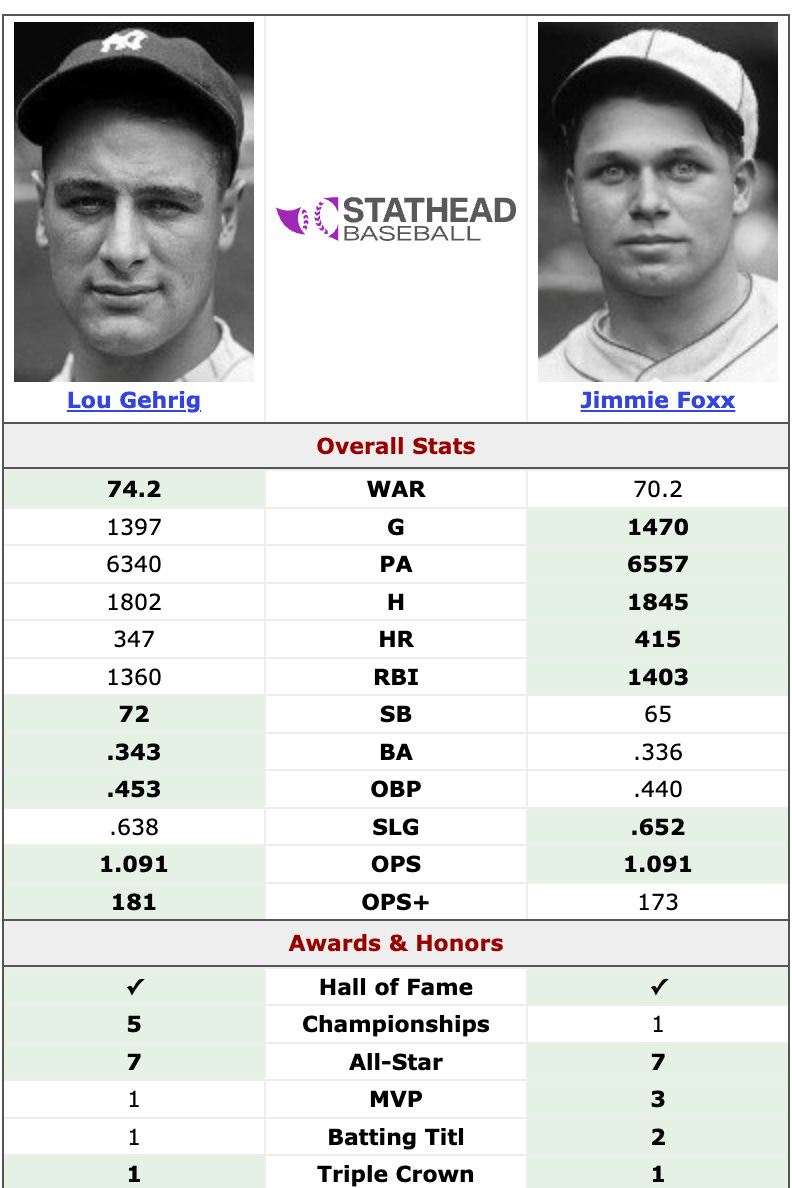
Slash Line (AVG/OBP/SLG): .336 / .440 / .652
WAR: 70.2
OPS+: 173
Hits: 1,845
Home Runs: 415
RBIs: 1,403
Runs: 1,244
Accolades: 1x World Series, 7x All- Star, 3x MVP, 2x Batting Title, 1x Triple Crown
1940s
Ted Williams – Boston Red Sox
Williams lost three years to World War II in the 1940s, and he still won the decade by a large margin. His two Triple Crowns are obviously impressive, but he narrowly missed out on two more. One he lost by 5 RBIs, and the other by .0002 in BA. He was also robbed of three move MVPs (go look into them, you might vomit BOTH TIMES HE WON TRIPLE CROWN HE LOST THE MVP).
A lot of people assume the other choice would be Joe DiMaggio, but I would have to go with Stan Musial. I will lay all their stats below and let you choose that yourself.
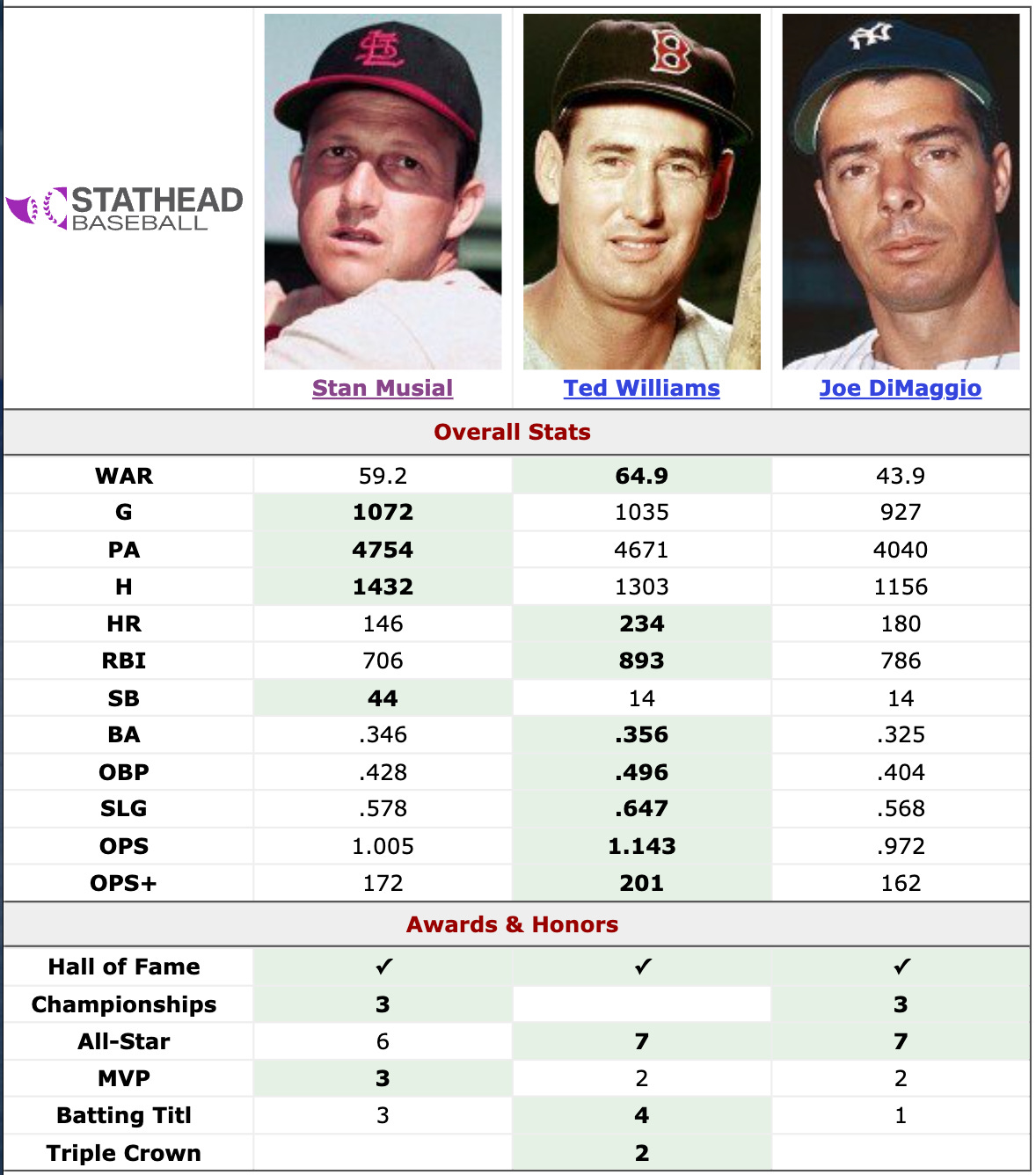
Slash Line (AVG/OBP/SLG): .356 / .496 / .647
WAR: 64.9
OPS+: 201
Hits: 1,303
Home Runs: 234
RBIs: 893
Runs: 951
Accolades: 7x All-Star, 2x MVP, 4x Batting Title, 2x Triple Crown
1950s
Mickey Mantle – New York Yankees
Continuing to alternate Red Sox and Yankee players, I am going with Mantle for the 1950s. You could, and I almost did, make the argument for Williams again in the 1950s. He essentially missed two more seasons for the Korean War, and if you average everything out, he would be matching Mantle across the board. I won’t make the argument, but I’ll allow you to look it up.
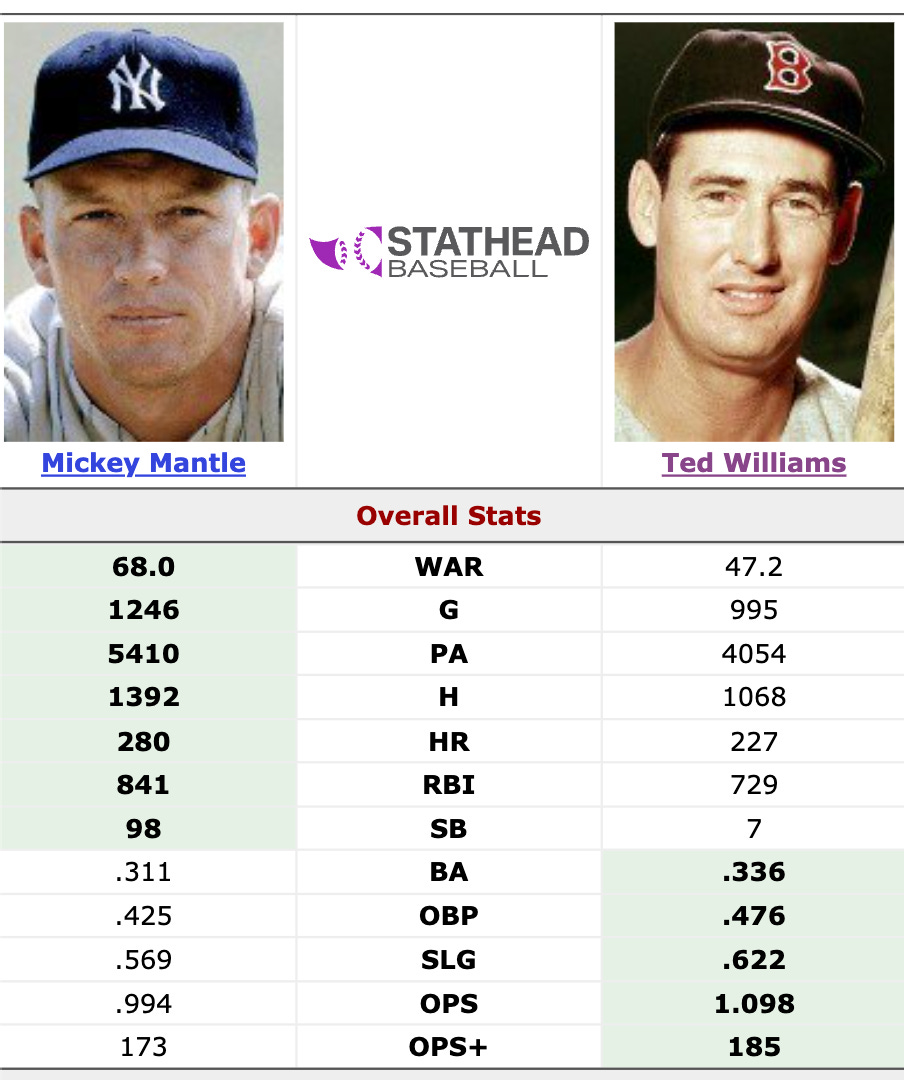
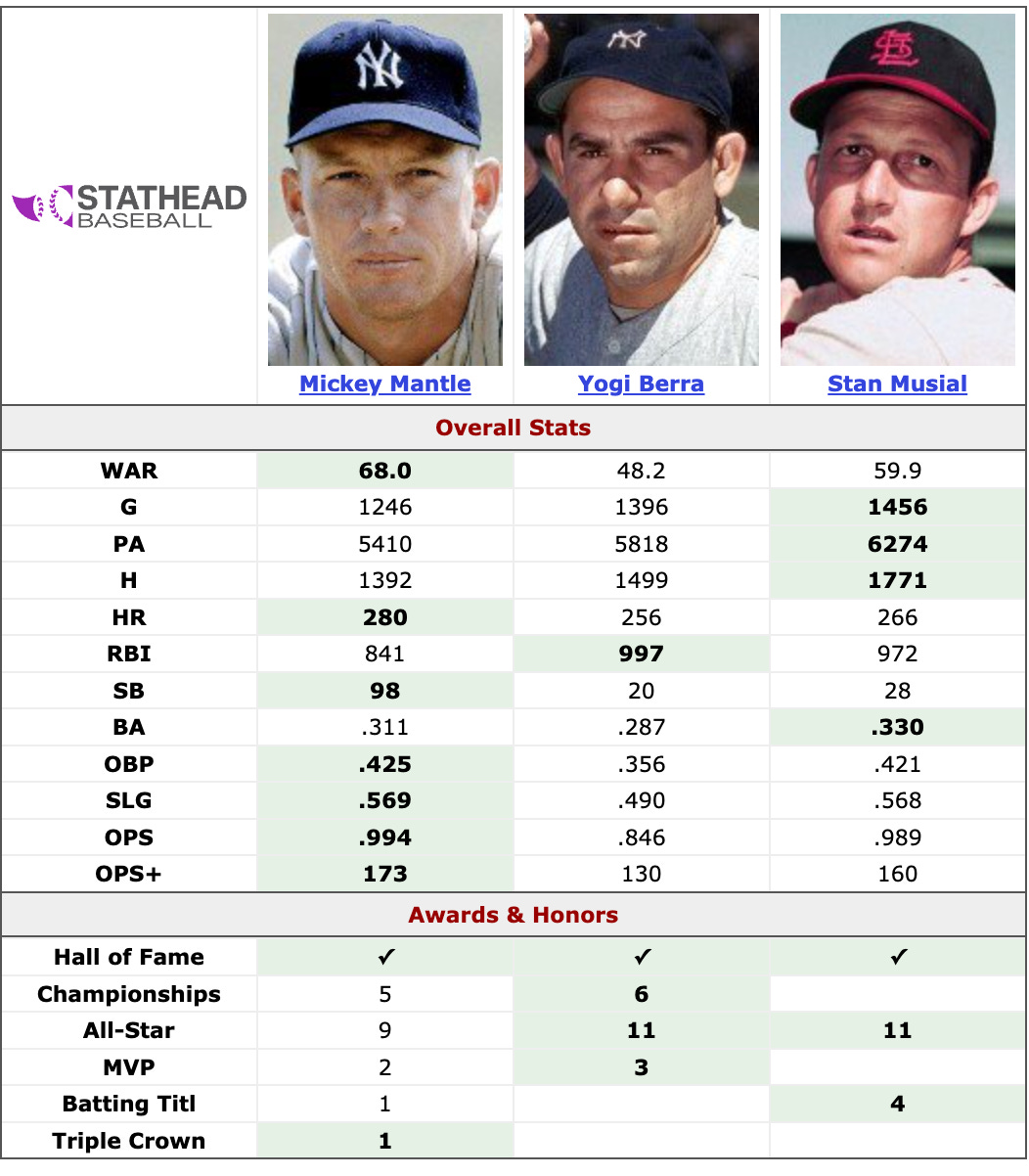
Outside of Williams, you would have to look at Yogi Berra and Stan Musial. Musial was the most consistent player, and his four batting titles are compelling. But his teams were bad throughout the ‘50s, and he didn’t grab any MVPs.
So, we pivot to Yogi Berra. While I have Berra as the most excellent catcher of all-time, I have to stay consistent with my thoughts on his MVPs. While no one is taking the three away from him, he doesn’t sniff those awards by today’s standards.
While it might feel like I am arguing against Mantle, and I sort of am, it just solidifies his position as the best of the decade. The rings, awards, and five-tool stats make him the best player of the decade.
Slash Line (AVG/OBP/SLG): .311 / .425 / .569
WAR: 68.0
OPS+: 173
Hits: 1,392
Home Runs: 280
RBIs: 841
Runs: 994
Accolades: 5x World Series, 9x All-Star, 2x MVP, 1x Batting Title, 1x Triple Crown
1960s
Willie Mays – San Francisco Giants
The 1960s were the hardest decade for me to decide on. It was Willie Mays or Hank Aaron, with no one else really even close. I switched my player about five times throughout this process. As I write this, I am still unsure who to pick.
Their stats are comparable across the board; both teams were outstanding the entire decade (only one losing season for the Braves), and they were elected to every All-Star game.
But I think I have to go with Willie Mays.
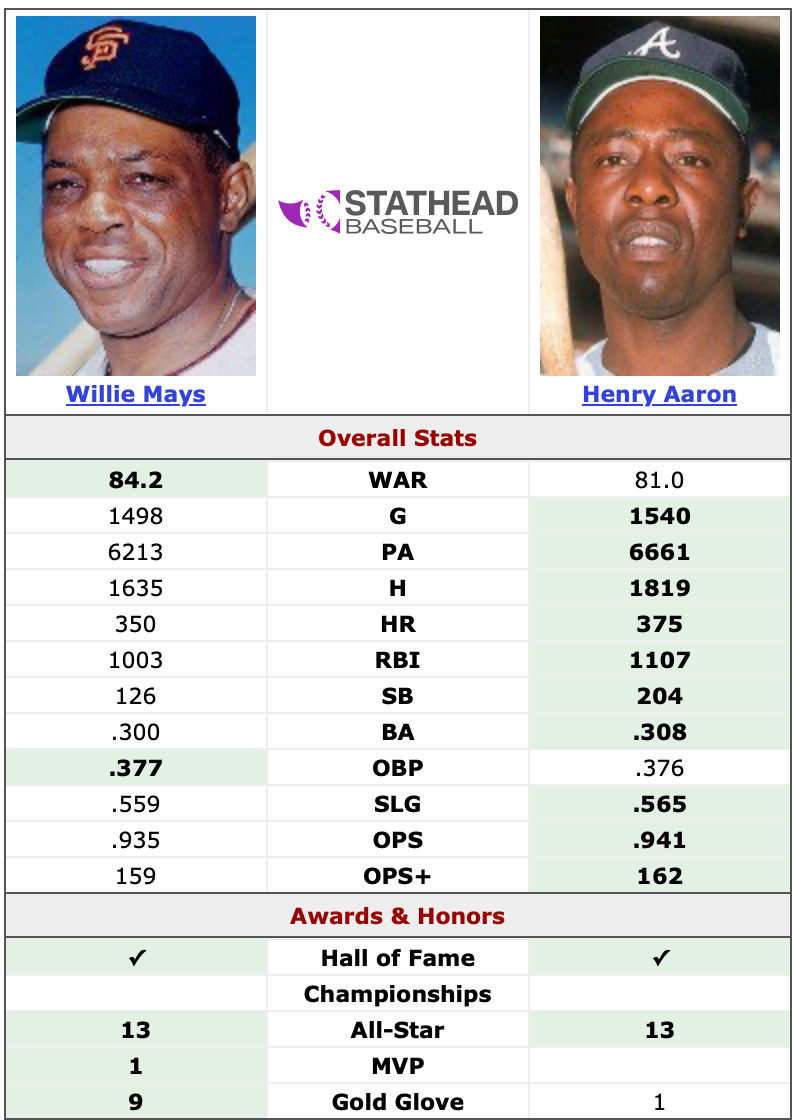
Slash Line (AVG/OBP/SLG): .300 / .377 / .559
WAR: 84.2
Hits: 1,819
Home Runs: 375
RBIs: 1,107
Runs: 1,091
1970s
Johnny Bench – Cincinnati Reds
The 1970s didn’t have an obvious runaway best player at first glance – you could make cases for several stars – but ultimately Johnny Bench emerged as the decade’s top player. Bench, the Hall of Fame catcher for the Cincinnati Reds, was the heart of the “Big Red Machine,” a team that dominated the era with back-to-back World Series titles in 1975 and 1976. As a catcher, Bench put up numbers that were unheard of for the position: he led the National League in home runs twice (1970, 1972) and RBIs three times during the decade, en route to two NL MVP awards (1970 and 1972). His 45-homer, 148-RBI campaign in 1970 stands as one of the greatest seasons ever by a catcher. Bench was also a defensive wizard, winning the Gold Glove every year from 1968 through 1977, and possessed a fearsome throwing arm that shut down opposing running games.
Joe Morgan (Bench’s teammate and a two-time MVP in ’75 and '76) had a tremendous 1970s as well. However, Bench’s combination of elite offense, leadership, defensive excellence at the game’s most demanding position, and playoff pedigree gives him the edge.

Slash Line (AVG/OBP/SLG): .267 / .349 / .491
WAR: 58.9
OPS+: 132
Hits: 1,396
Home Runs: 290
RBIs: 1,013
Runs: 792
Accolades: 2x World Series, 10x All-Star, 2x MVP, 8x Gold Glove, 1x WS MVP
1980s
Mike Schmidt – Philadelphia Phillies
The Philadelphia Phillies’ third baseman won three National League MVP awards in the ’80s (1980, 1981, 1986), more than any other player in that span. At the plate, Schmidt led all players of the decade with 313 home runs, claiming four home run titles in the ’80s and leading the league in RBIs four times. Schmidt also took home six Gold Glove awards (he earned 10 Gold Gloves in his career) for his stellar play at third base.
In 1980, Schmidt led the Phillies to a World Series championship, earning World Series MVP honors. Throughout the decade, the league saw great contact hitters like Wade Boggs and speedsters like Rickey Henderson. Bogg’s .352 BA in the decade would match Honus Wagner, and only be bested by Williams and Cobb, if we were to choose him. Henderson could have retired in 1989 and still be 4th All-Time in stolen bases after just one decade.
Where Henderson and Boggs were 22 and starting their careers as the 1980s began, Schmidt was already in his 30s, and 1989 would be his farewell season. I have a soft spot for players who dominate into their 30s, and winning three MVPs doesn’t hurt either.
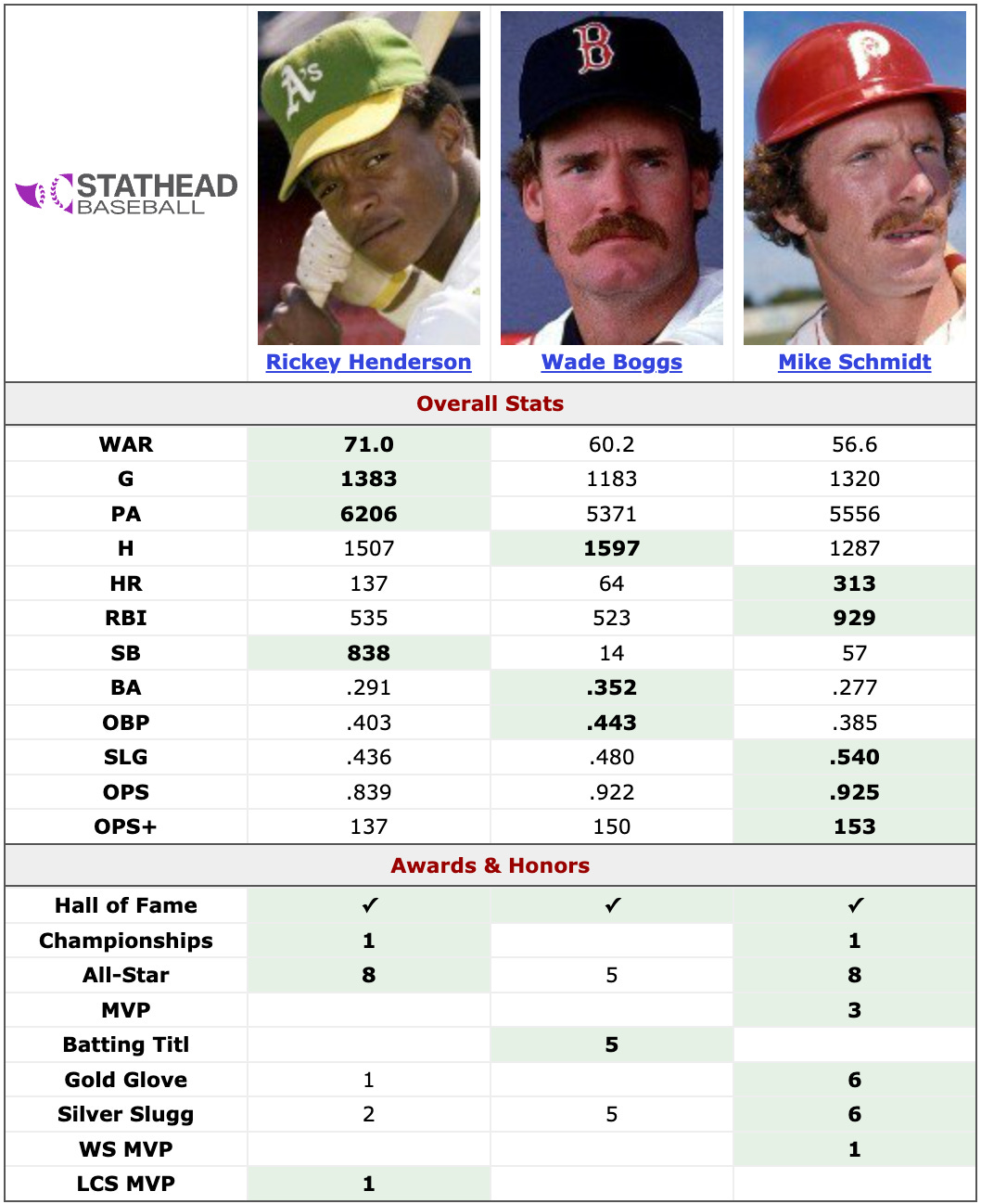
Slash Line (AVG/OBP/SLG): .277 / .385 / .540
WAR: 56.6
OPS+: 153
Hits: 1,287
Home Runs: 313
RBIs: 929
Runs: 832
Accolades: 1x World Series, 8x All-Star, 3x MVP, 6x Gold Glove, 1x WS MVP
1990s
Ken Griffey Jr. – Seattle Mariners
As I have written this blog, I have begun to put myself in a box. When it comes down to two close players, I have been opting to look at awards like MVP to break the tie.
Now I am in a conundrum because I am not going to pick Barry Bonds.
Whenever I see people arguing about Barry Bonds’ inclusion, I often think of the Michael Jordan quote from The Last Dance: “That’s you. Because you never won anything.”
I loved Barry Bonds growing up I loved his chase of Ruth/Aaron and his massive home runs. But then we found out he cheated. I hate cheaters.
The vast majority of MLB Hall of Famers hate cheaters as well, and were vocal about not having the steroid guys in the hall. Sadly, those guys are dying, and I think we are entering a new era where Bonds and those guys get in.
Why? Because the people who will end up choosing them “never won anything.” They don’t know what it feels like to be cheated because they never left Little League.
All that being said, Ken Griffey Jr is my pick for the 1990s. If he had cheated and saved his body as Bonds did, he would have had the same numbers.
He didn’t.

Slash Line (AVG/OBP/SLG): .302 / .384 / .581
Hits: 1,622
Home Runs: 382
RBIs: 1,091
Runs: 1,002
2000s
Albert Pujols – St. Louis Cardinals
Debuting in 2001, Pujols embarked on one of the greatest starts to a career in MLB history. He hit .300+ with 30+ home runs and 100+ RBIs in every season from 2001 through 2009. In the 2000s, Pujols won three NL MVP awards (2005, 2008, 2009) and earned nine All-Star selections.
Pujols also carried the St. Louis Cardinals to two National League pennants and a World Series championship in 2006, adding to his dominance.
Slash Line (AVG/OBP/SLG): .334 / .427 / .628
Hits: 1,717
Home Runs: 366
RBIs: 1,112
Runs: 1,071
2010s
Mike Trout – Los Angeles Angels
I am sure there will be some Aaron Judge and Shohei Ohtani fans who begin to convulse before realizing both players started late in this decade.
Mike Trout dominated the 2010s from a WAR, award, and overall stat perspective. His first real season was in 2012, so he produced 72.1 bWAR in only 8 years. That ratio is better than anyone on this list outside Ruth.
Has he fallen off a cliff? Yes. Did his teams kind of stink? Yes. But that doesn’t take away from how dominant he was for those eight years.
A lot of people online say Miguel Cabrera should be in contention. It isn’t even close.
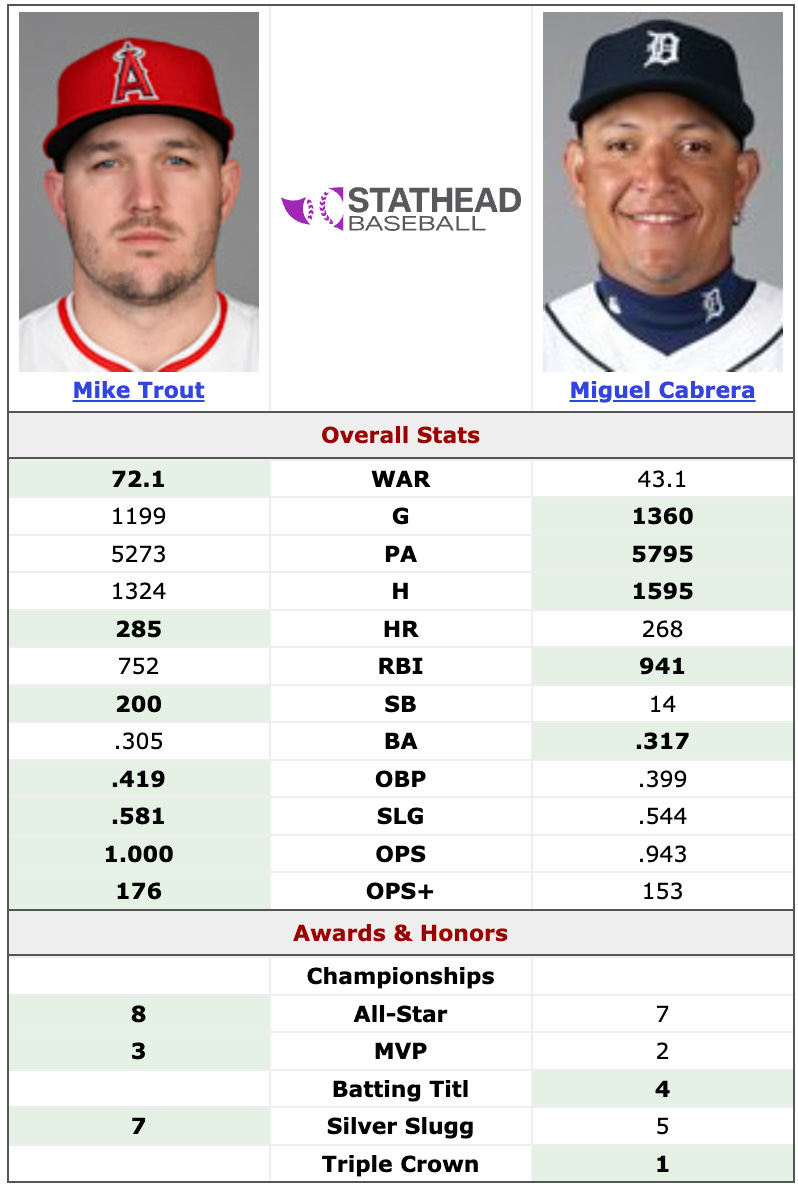
Slash Line (AVG/OBP/SLG): .306 / .419 / .581
Hits: 1,324
Home Runs: 285
RBIs: 752
Runs: 903
If you enjoyed this blog, and want to see more like it, please consider subscribing below.
Great stuff. 70s was the tough one
I was not expecting to see Johnny Bench in the 70s top spot! That BA throws me off the scent, compared to top hitters of other decades. Rod Carew had the insane BA, but few walk and zero power. Same goes for Pete Rose.
But then a guy like... say George Brett, he started his major league career in the middle of the decade, I wonder where he would be on a list using another arbitrary range, like 1975-85. Eddie Murray is another big one.
Other guys would be high up there on the list comprising 1965-75, like maybe Willie McCovey, Dick Allen, and Yaz.